2026-05-29
Personal Insights on Male Monolid Ptosis Correction
A professional perspective on male monolid ptosis correction, highlighting the risks of excessive skin removal and the limitations of non-incisional methods.
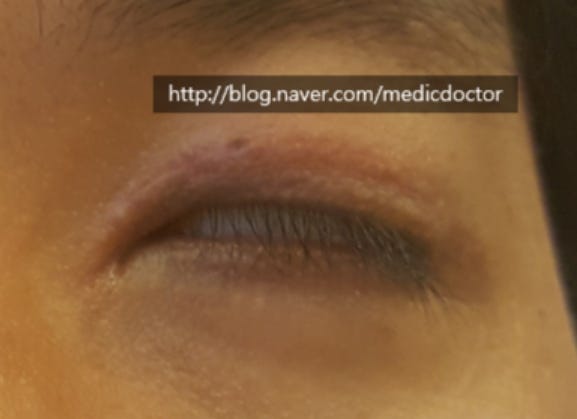
I believe I have been performing #Male Monolid Ptosis Correction surgeries extensively since around 2015.
#MaleMonolidPtosisCorrection #MalePtosisCorrection #MaleIncisionalPtosisCorrection
While I performed them occasionally before then, the volume increased significantly over the last three years. Based on these cases, I have had the opportunity to present at academic conferences and am currently working on a research paper.
However, as I present more and publish papers, neighboring clinics have started referring their difficult cases to me for resolution.
There are two critical points to consider regarding male monolid ptosis correction—precautions that must be taken.
First, performing a ‘monolid’ ptosis correction does not mean you should eliminate the double eyelid fold by removing all the excess skin.
If the eyes cannot close properly… what then? It is a distressing situation.
Second, one should not have blind faith in #Non-Incisional #MonolidPtosisCorrection.
Of course, everyone prefers a non-incisional approach for faster recovery. However, in men, not only is there a higher probability of the results loosening, but non-incisional methods also have a limited correction range. If a surgeon overreaches by pulling the Müller’s muscle too tightly, the patient will experience extreme discomfort.
It is truly unfortunate when patients come to me for an incisional revision after regretting their initial non-incisional procedure.
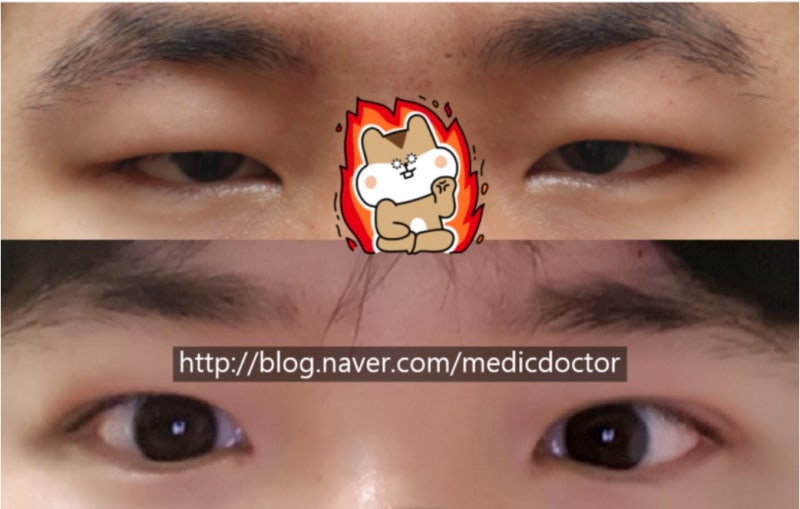
The patient above had thick eyelids and significant pupil coverage.
This case required not just fat removal, but the appropriate excision of the orbicularis oculi muscle, retro-orbicularis oculi fat (ROOF), and the septum.
Such results are impossible to achieve with a non-incisional method.
Frequently Asked Questions
For men's monolid ptosis correction, can a lot of skin be removed?
No, excessive skin should not be excised. If too much skin is removed with the aim of completely eliminating the double eyelid, severe side effects such as the eye not closing properly can occur, so extreme caution is necessary.
Is the non-incisional method always better for monolid ptosis correction?
No. You should not blindly trust the non-incisional method. While non-incisional surgery has the advantage of faster recovery, for men, there is a higher chance of the correction loosening after surgery, and the amount that can be corrected is limited. Over-correction can lead to significant discomfort.
Can eyes become uncomfortable after non-incisional ptosis correction?
Yes, discomfort can occur. The non-incisional method inherently offers a limited amount of correction, and if the Müller's muscle is excessively pulled to forcibly increase this amount, significant discomfort in the eyes can be experienced.
Is non-incisional ptosis correction possible for men with thick eyelids?
No, in such cases, the non-incisional method may not be possible. Eyes with thick eyelids and significant pupil obstruction require the removal of not only fat but also the orbicularis oculi muscle, the fat layer behind the orbicularis oculi, and the septum, thus necessitating an incisional surgical method.