2026-05-29
Myths and Truths About Ptosis Correction Side Effects (Incisional vs. Non-incisional)
Explore the causes of ptosis correction side effects, from surgical methods to patient sensitivity, and learn why choosing an experienced specialist is key.
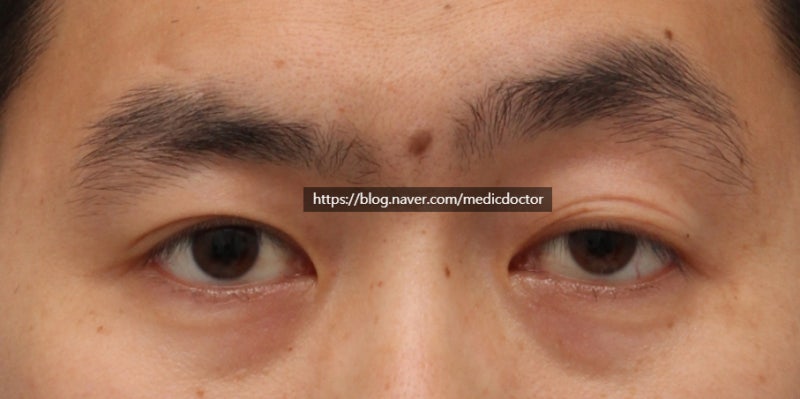
Recently, many patients have visited for consultations regarding surgery.
In particular, those who have been wandering through the vast sea of internet information—YouTube, online forums, and so on.
Occasionally, some come in already firmly believing that ptosis correction will 100% result in side effects.
Is that really the case?
No. Ptosis correction is actually an excellent procedure. So why do side effects occur?
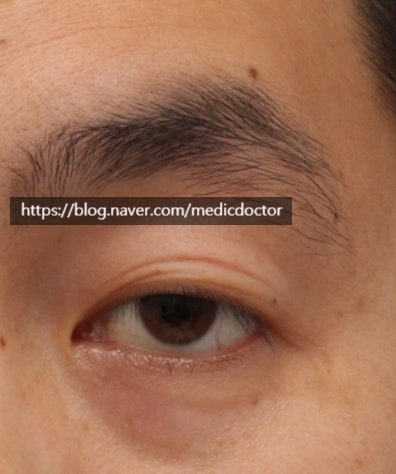
It is because the surgery was performed inappropriately, or it occurs in patients who are extremely sensitive.
Please note that this is based on my personal experience and subjective opinion, and I acknowledge that others may have different perspectives.
First, let’s look at inappropriate cases.
1. Inappropriate Surgical Method
For example, let’s consider non-incisional ptosis correction. Personally, I believe this method is suitable for patients with very mild ptosis (those who open their eyes almost normally but want them to look slightly larger).
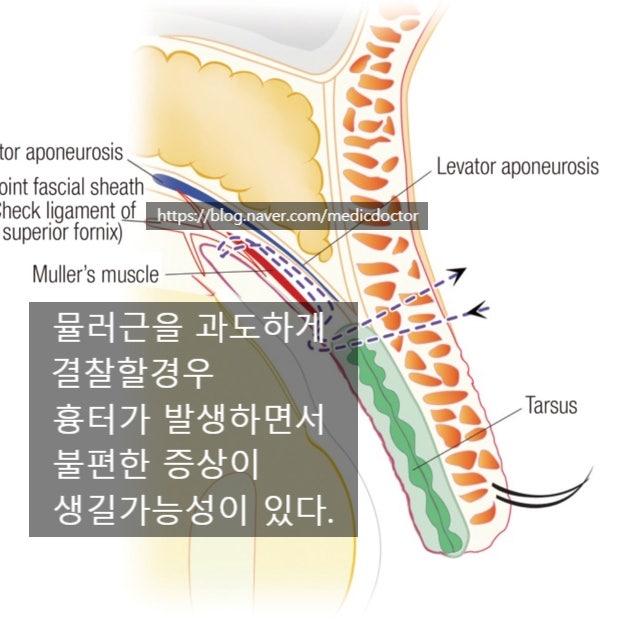
However, if the Mueller’s muscle (part of the eye-opening muscle) is excessively ligated (tied) through the conjunctiva, it can cause a severe pulling sensation.
In such cases, using the levator aponeurosis through incisional ptosis correction is actually much less burdensome.
2. Severe Moderate-to-High Degree Ptosis
In these cases, because the ptosis is severe, the original eye-opening muscles lack strength and elasticity.
The strength is congenitally lacking. For example, imagine trying to bend or straighten your arm when the arm muscle itself is underdeveloped.
In this situation, no matter how much you try to stretch the biceps, if the arm itself won’t bend, it won’t develop. You can artificially force the arm to bend, but it becomes difficult to straighten it again. It is a similar principle.
Therefore, if the levator muscle is pulled significantly, the eyes may not close fully. However, humans are creatures of adaptation. No matter how much the eyes don’t close initially, they improve significantly over time and eventually close. While the patient might sleep with their eyes slightly open, in most cases, there are no major complications.
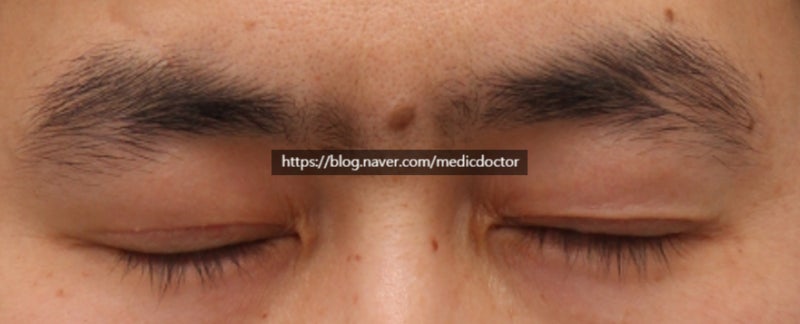
3. Side Effects Occurring During Incisional Ptosis Correction
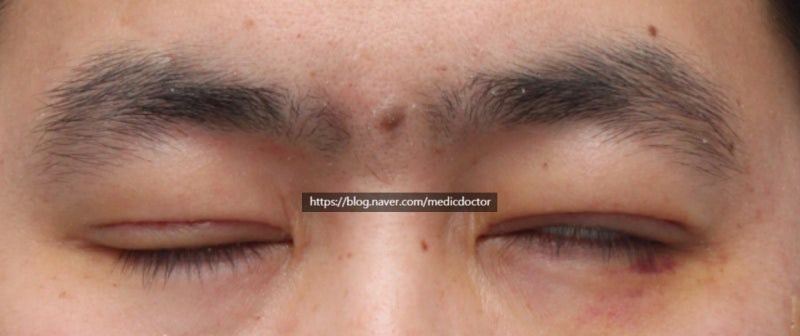
Actually, this is often an issue with the incisional double eyelid surgery itself rather than the ptosis correction. Nowadays, ptosis correction is frequently performed alongside incisional double eyelid surgery. Complications arise when an inexperienced surgeon or a non-specialist excessively manipulates the orbicularis oculi muscle (the muscle that closes the eye), causing damage.
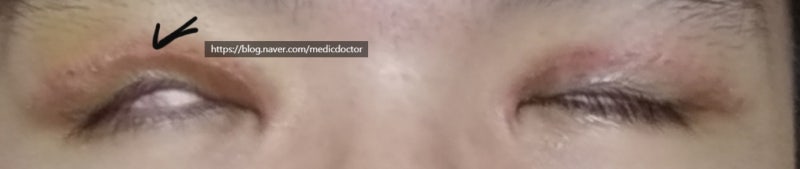
If the orbicularis oculi muscle in the area below the double eyelid line is severely damaged, the eye will not close.
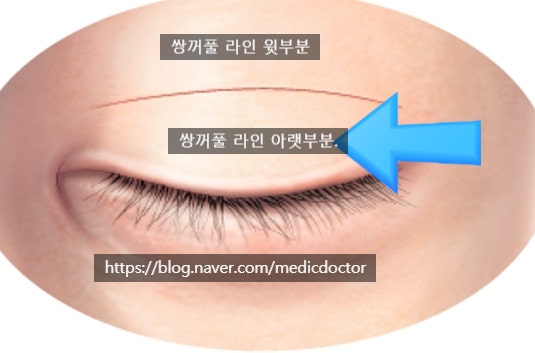
In such cases, the eye may permanently fail to close, significant scarring may occur, or various other side effects may arise.
Another Factor: Sensitive Cases
Just as some sensitive people get headaches simply by changing their glasses or drinking coffee, some patients react more strongly to surgery.
To be honest, there is no clear-cut answer for these cases. The issue might not even be the ptosis correction; it could be the incisional double eyelid surgery or even a non-incisional ptosis correction.
Occasionally, symptoms can occur even with the buried suture method (so-called ‘pinching’) rather than non-incisional ptosis correction. If a person is extremely sensitive, I recommend they do not undergo surgery at all.
If the surgery is performed well, it can be considered safe in over 99% of cases. Since there is no such thing as 100% in medicine, I will leave that 1% margin.
As long as there is no excessive manipulation during surgery and you avoid repeated revision surgeries—especially for the first surgery—there is a high probability that there will be no major issues. So, feel at ease and seek surgery from a skilled, board-certified plastic surgeon.
http://www.k-health.com/news/articleView.html?idxno=47914
I am attaching an interview article I did with a newspaper in the past.
Frequently Asked Questions
Does blepharoplasty always cause side effects?
No, it is a misunderstanding that blepharoplasty always causes side effects. Side effects mainly occur when an inappropriate surgical method is chosen that does not suit the patient's condition, or when the patient is extremely sensitive. Most procedures are safe when performed by an experienced specialist.
In what cases is non-incisional blepharoplasty suitable?
Non-incisional blepharoplasty is suitable for patients with very mild ptosis. It is effective when you want to make your eyes slightly larger even though they open almost normally, but caution is needed as excessive muscle tightening can cause severe pulling symptoms.
Can eyes not close after severe ptosis surgery?
Yes, your eyes may not close completely in the early stages after surgery. If the muscles are pulled significantly to correct severe ptosis, the eyes may temporarily not close, but most people adapt over time and the eyes will close. Even if they remain slightly open during sleep, there are often no major complications.
What causes eyes to not close permanently after incisional blepharoplasty?
This is because an inexperienced medical professional excessively manipulated and damaged the orbicularis oculi muscle during surgery. The orbicularis oculi muscle is responsible for closing the eye, and if this area is severely damaged, it can lead to permanent inability to close the eye or severe scarring.
Is blepharoplasty suitable for sensitive individuals?
No, surgery is not recommended for extremely sensitive individuals. If you are so sensitive that even changing glasses causes headaches, it is best to avoid surgery, as even non-incisional blepharoplasty or simple buried suture double eyelid surgery can cause headaches or discomfort.