2026-05-29
Lower Eyelid Fat Repositioning Incision, Lower Eyelid Fat Removal Surgery
Learn about lower eyelid fat repositioning and removal, including transconjunctival and external incision methods. This article explains how to address under-eye hollows caused by the tear trough ligament (TTL) and the process of fat repositioning.
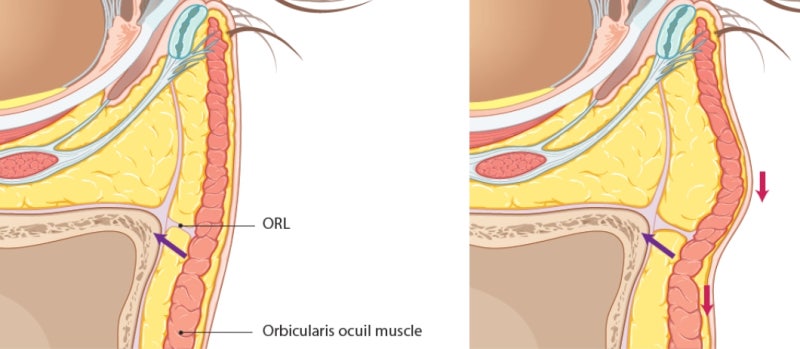
This article discusses methods for lower eyelid fat repositioning incisions and lower eyelid fat removal surgery.
Typically, there are methods involving an external incision and methods involving surgery through the conjunctiva.
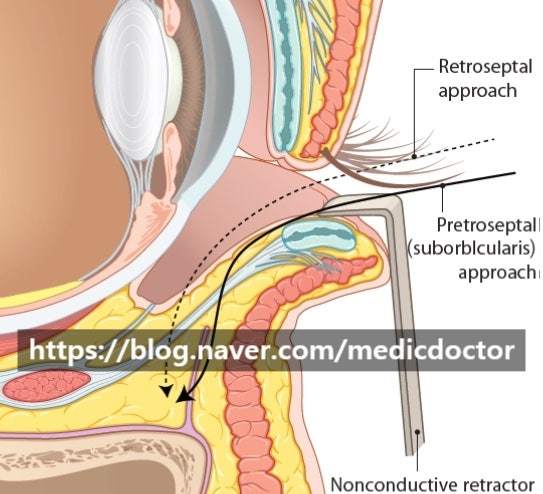
The approach is made through the conjunctiva, like this.
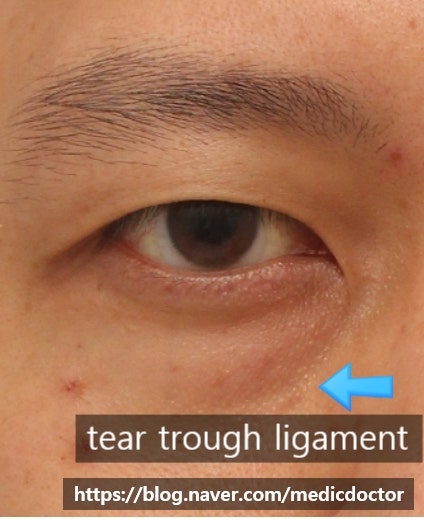
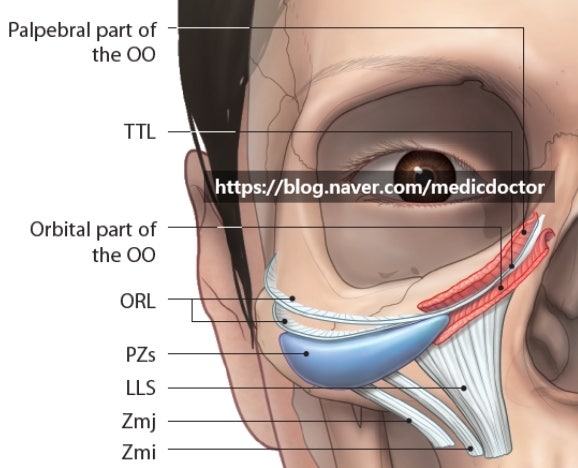
If you look at this person, there's a hollow area under the eyes, and that's the target for the surgery.
This area has a ligament-like structure under the eye, called the TTL (tear trough ligament).
As the fat protrudes, the TTL, which is attached to the bone, creates a visible boundary.
After partially dissecting and releasing the TTL, the fat is repositioned.
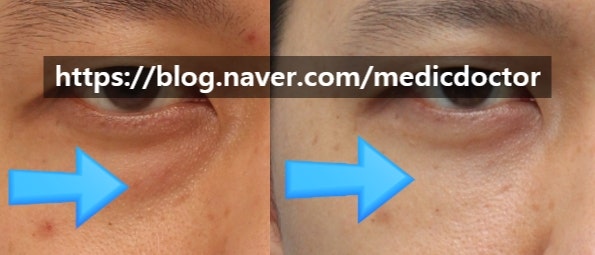
These are photos taken 6 months before and after the surgery. The defined boundary has disappeared.
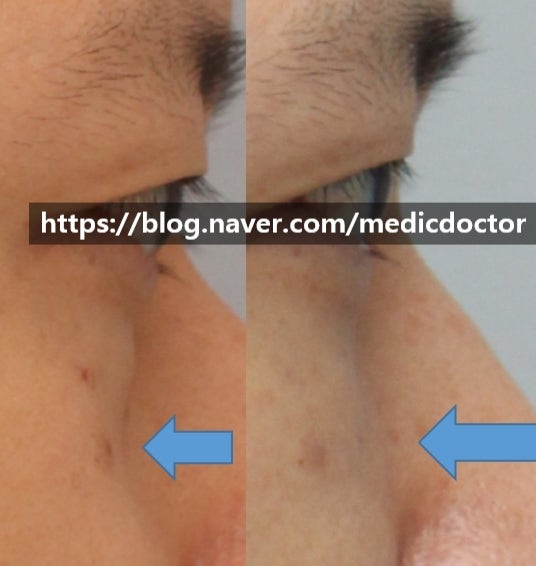
If there's a slightly sunken area in the anterior cheek, it can be supplemented with fat grafting or similar procedures.
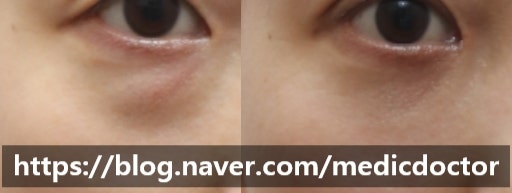
While the defined boundary improves, dark circles caused by hyperpigmentation will not disappear.
The content here is partially excerpted from Volume 2 of ‘Aesthetic Plastic Surgery’ by Gunja Publishing, in which I participated as a co-author.
Frequently Asked Questions
What are the incision methods for lower eyelid fat repositioning surgery?
Yes, there are two methods: incising the outer skin or incising through the conjunctiva inside the eye. Typically, the surgery is performed by accessing through the conjunctiva, targeting the hollowed areas under the eyes, which helps reduce visible scars.
What causes the appearance of a boundary and puffiness under the eyes?
This is due to the tear trough ligament (TTL) being firmly attached to the bone. In this state, the surrounding lower eyelid fat protrudes, creating a difference in height with the ligament area, making it appear as a visible boundary and a sunken groove.
How exactly is lower eyelid fat repositioning surgery performed?
The surgery involves partially dissecting and releasing the tear trough ligament (TTL) that is attached to the bone, then evenly repositioning the protruding fat. This can smoothly improve the puffiness and defined boundaries under the eyes.
Will dark circles caused by hyperpigmentation disappear after surgery?
No, dark circles caused by hyperpigmentation will not disappear. While the surgery smoothly improves structural boundaries and contours caused by lower eyelid fat protrusion, skin pigmentation issues themselves cannot be resolved by surgery alone.
What if the anterior cheek is sunken during lower eyelid surgery?
Fat grafting is performed concurrently in the anterior cheek area to replenish volume. If a slightly sunken anterior cheek is observed during lower eyelid fat repositioning surgery, fat grafting can further improve the overall lower eyelid and anterior cheek line more naturally.