2026-05-29
Case Study: Correcting Uneven Eyes and Asymmetric Double Eyelids with Ptosis Correction
A case study on correcting asymmetrical eyes using ptosis correction. Learn why incisional methods are often necessary for achieving symmetry in complex cases.
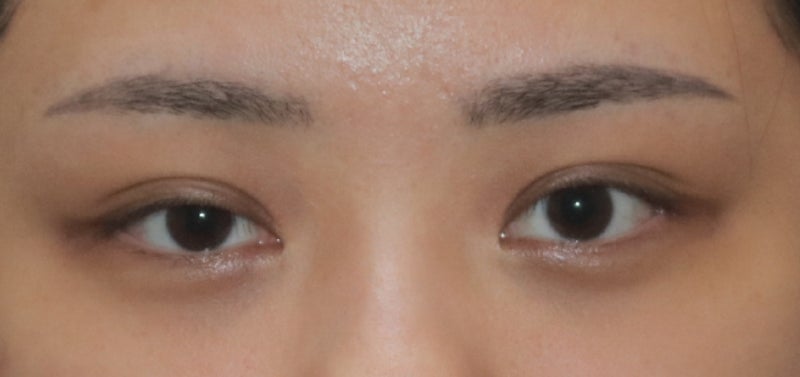
Case Study: Correcting Uneven Eyes and Asymmetric Double Eyelids with Ptosis Correction
In today’s post, I will discuss the process of correcting uneven eyes through ptosis correction surgery.
I have written about this topic previously on my blog, so please feel free to refer to it for more context.
https://blog.naver.com/medicdoctor/223050025325
The patient in this case had previously undergone surgery, including non-incisional ptosis correction, but the asymmetry remained uncorrected. It is extremely difficult to fix uneven eyes using non-incisional methods alone. Unless the issue is simply ‘pseudoptosis’—where symmetry can be achieved just by creating a double eyelid fold—non-incisional ptosis correction rarely produces a perfectly balanced result.
Looking at this patient, the eye on the left side of the photo (the patient’s right eye) appears significantly sleepier than the other side.
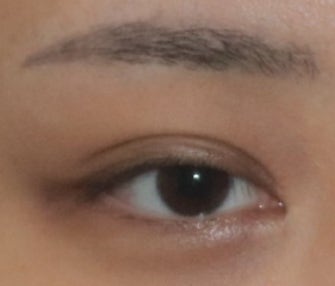
In cases like this, if the patient’s right eye is their dominant eye, there is a possibility of ‘Hering’s Law’ (Hering’s phenomenon) occurring—a topic I will cover in a future post.
All these factors must be carefully considered when performing the surgery.
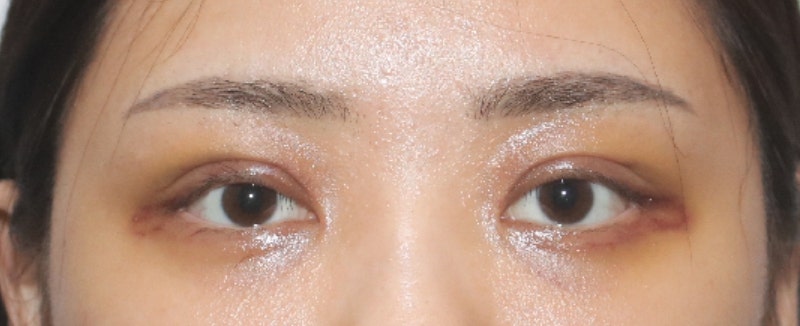
This is the result one week after surgery. Although there is still some swelling and bruising, you can see that the pupils are now well-aligned and symmetrical.
Note: When ptosis correction is performed more intensely on one side, the rate at which swelling subsides may differ between the eyes. This varies by individual.
Please also take a look at the post below:
https://blog.naver.com/medicdoctor/222723859506
Gangnam Seoyeon Plastic Surgery will always continue to do our best for our patients.
Frequently Asked Questions
Is it possible to correct asymmetrical eyes with non-incisional ptosis correction?
No, it is very difficult to achieve symmetry with non-incisional ptosis correction unless it is a case of pseudoptosis. If creating double eyelids alone does not achieve symmetry, other methods such as incisional surgery should be considered.
Why should the dominant eye be considered during asymmetrical eye surgery?
Yes, because if the sleepy-looking eye is the dominant eye (the eye primarily used), there is a possibility of the Hering phenomenon occurring after surgery. Therefore, all these phenomena should be comprehensively considered before surgery to establish a surgical plan.
Can the swelling reduction rate differ between the two eyes after asymmetrical ptosis correction surgery?
Yes, there can be a difference in the rate at which swelling subsides between the two eyes. If one eye undergoes more ptosis correction or the degree of correction differs, the recovery speed may vary, and this is subject to individual differences.
What is the typical condition one week after asymmetrical ptosis correction surgery?
One week after surgery, it is common for swelling and bruising to still be present. However, as seen in the examples in the main text, even with swelling, the exposure of both pupils can be confirmed to be well-symmetrical.