2026-05-29
Case Study: Men’s Monolid Ptosis Correction and Epicanthoplasty Restoration
A case study of a male patient who underwent monolid ptosis correction and epicanthoplasty restoration to correct high double eyelids and an over-exposed inner corner.
I have brought a case study of a patient who underwent men’s monolid ptosis correction and epicanthoplasty restoration.
The video below shows the patient before the surgery.
The patient complained that his double eyelids were too high, making him look sleepy, and that his previous epicanthoplasty was overdone.
There was also a slight presence of sanpaku eyes (three-white eyes).
Please watch the pre-operative video.
Looking at the video, the double eyelid line is slightly high and visible, and the Mongolian fold at the front is excessively opened.
Since the epicanthoplasty was overdone, we first performed an epicanthoplasty restoration.
Following that, a secondary surgery was performed to lower and hide the double eyelid line.
While these procedures can be performed simultaneously, they were carried out in two stages according to the patient’s preference.
The men’s monolid ptosis correction was performed by applying the exact methods I mentioned in my research paper.

Refer to previous articles.
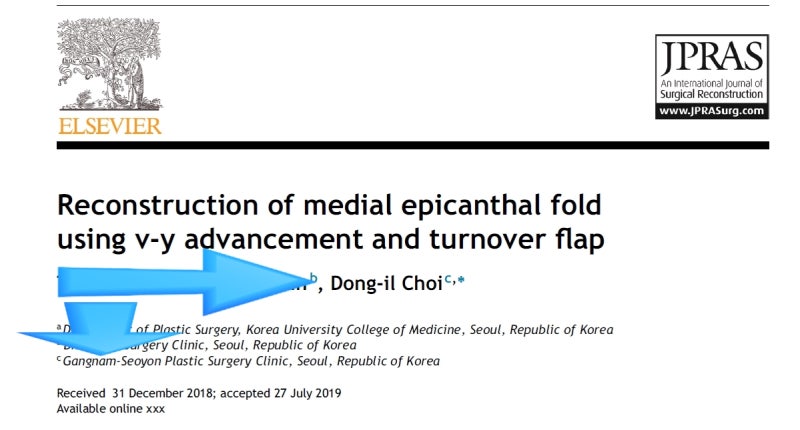
Additionally, the epicanthoplasty restoration was based on the following research paper.
This is a recently published paper.
It was featured in an international journal of plastic surgery.
The most critical aspect of epicanthoplasty restoration is ensuring that the scar does not widen.
Furthermore, the method for hiding the double eyelid involves performing proper ptosis correction while cleanly releasing existing adhesions.