2026-05-29
Undoing Non-Incisional Double Eyelid Surgery: Suture Removal and Reversing Natural Adhesion
Learn about undoing non-incisional (buried suture) double eyelid surgery, including suture removal and cases where the method might not be suitable.
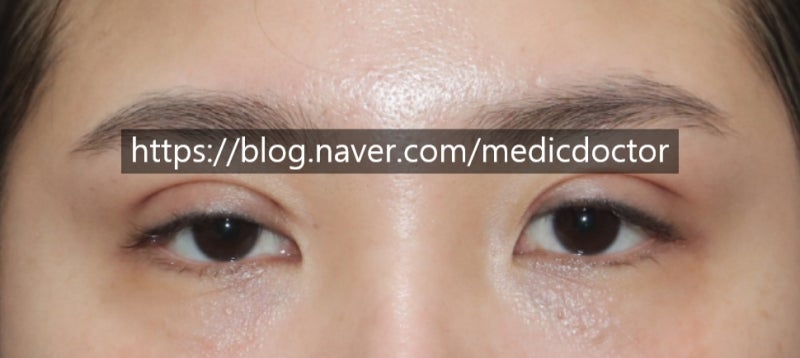
Undoing Non-Incisional Double Eyelid Surgery: Suture Removal and Reversing Natural Adhesion
A major advantage of the non-incisional (buried suture) method is the faster recovery time compared to the incisional method. However, good results can only be achieved when the procedure is applied to patients who are suitable candidates.
The following types of patients may experience poor results with the non-incisional method:
1. Significant skin sagging
– Especially in elderly patients or those with severe skin laxity.
2. Presence of ptosis
– Non-incisional ptosis correction has its limits for eyes that appear sleepy.
3. Thick skin
– The fold may unravel quickly or look unnatural.
4. Excessive fat
– The fold tends to loosen easily and leaves a heavy, puffy appearance.
I am posting a case of a patient who previously had surgery at another clinic.
The patient mentioned that their right eye was originally slightly smaller. When the line is forced too high on someone with skin sagging, it results in an unnatural look.
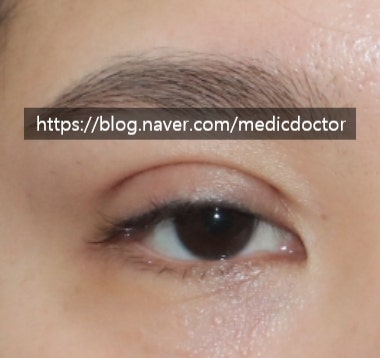
The patient stated that their eyes felt heavy and didn’t open fully immediately after the surgery.
The plan was to remove the existing sutures and perform the non-incisional method again at an appropriate height. (I actually recommended the incisional method, but the patient decided to proceed with that at a later date.)
The sutures are carefully located as shown below.
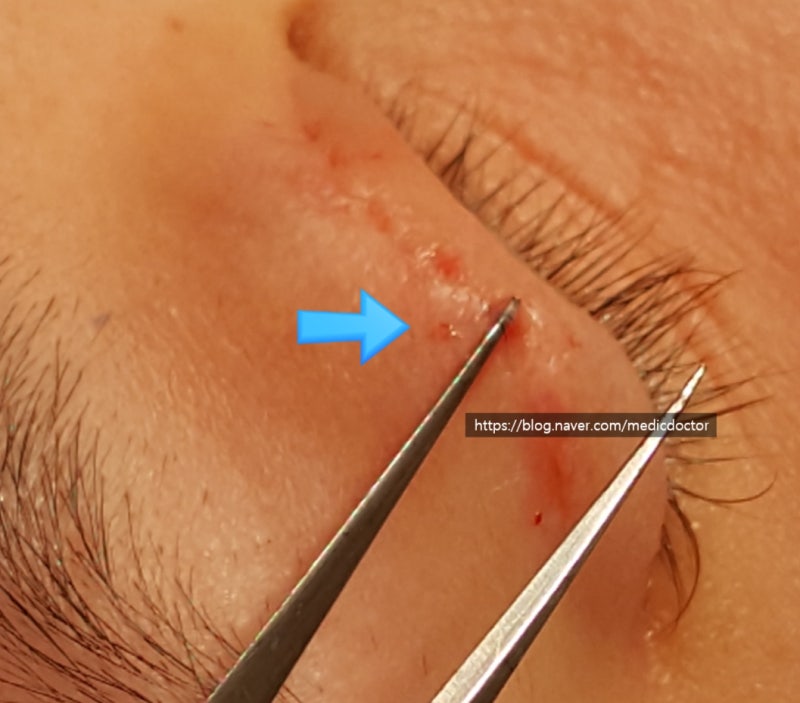
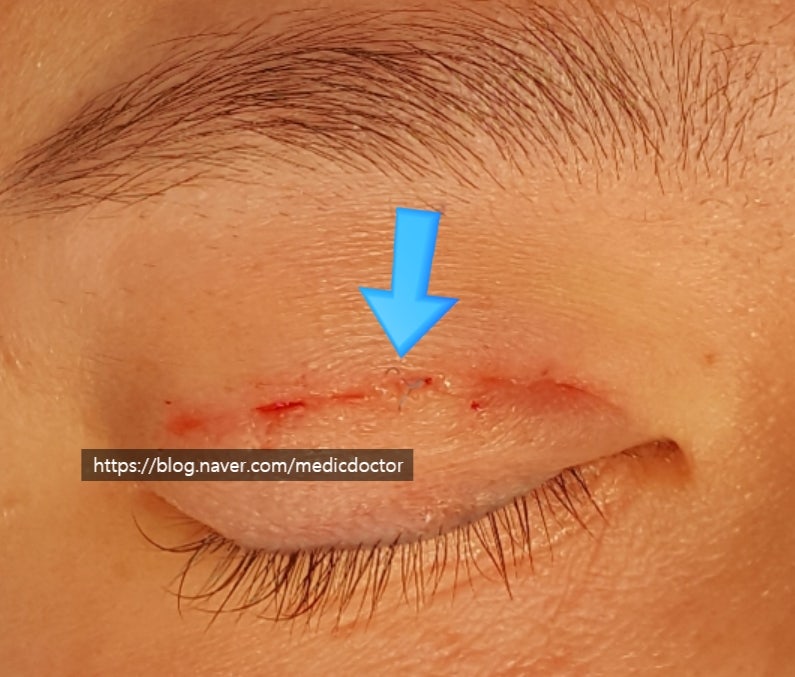
This is the view just before removing the sutures.
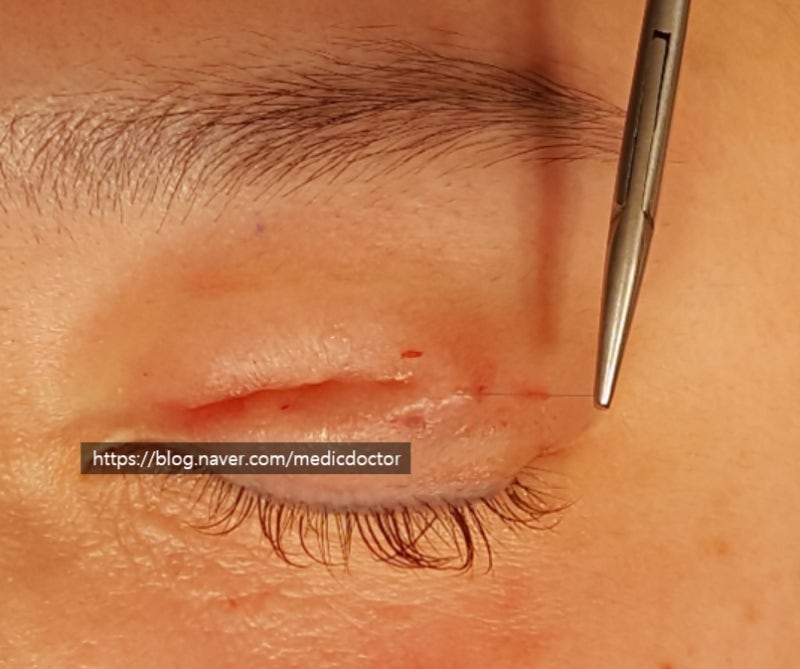
This shows the suture removal on the opposite side.
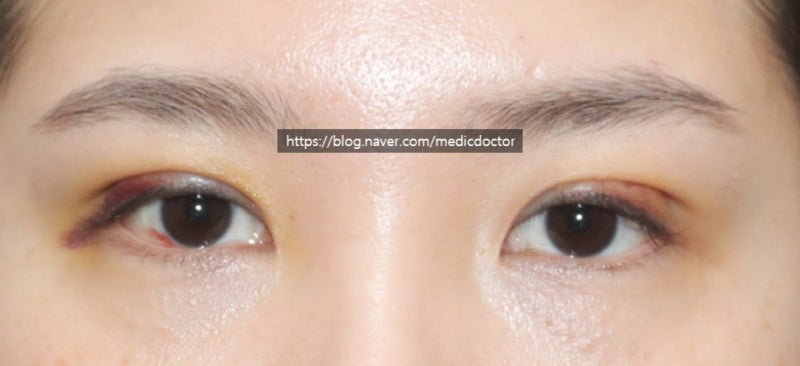
This is the 4th day after suture removal and re-performing the non-incisional method.
The appearance is much more natural than before. The shape is expected to improve significantly once the swelling subsides.
Finding buried sutures requires a lot of experience; otherwise, it’s like ‘finding a needle in a haystack.’
Additionally, this reversal is primarily feasible for the single-knot continuous method.
Frequently Asked Questions
What kind of eyes are not suitable for the buried suture double eyelid surgery?
Yes, the buried suture method is not suitable if there is a lot of skin sagging, ptosis, thick skin, or a lot of fat in the eyes. If the buried suture method is performed on such eyes, the double eyelid is likely to loosen quickly or the line may become unnatural.
My eyes don't open fully after buried suture double eyelid surgery. Can the threads be removed?
Yes, it is possible to remove the existing buried suture threads and perform revision surgery. If side effects such as an unnatural double eyelid line due to excessively high placement or incomplete eye opening have occurred, it is necessary to find and remove the existing threads through an experienced medical professional and then correct them to an appropriate height.
Can the threads from all buried suture double eyelid surgeries be removed?
No, it is not possible in all cases. According to the main text, it is only possible to find and remove existing buried suture threads if the surgery was performed using the single-knot continuous method. There are differences depending on the surgical method, so an accurate diagnosis is required.
Is buried suture thread removal surgery simple?
No, the process of finding buried suture threads is as difficult as finding a needle in a haystack. Therefore, it is important to have the surgery performed by a medical professional with extensive clinical experience to accurately find and remove the threads while minimizing damage to eye tissue.