2026-05-29
Ptosis and Double Eyelid Revision (Unreasonably High Line) Case Study
This case study details the revision of a patient's eyes, addressing ptosis and an excessively high double eyelid line, often referred to as 'sausage eyelids.' The patient's right eye showed significant retraction, resembling a startled expression, with a visible scleral show. The previous surgery resulted in severe scarring and an unnaturally high crease, which is generally undesirable for male patients who prefer a natural look where the eyelid crease is concealed. The revision involved loweri
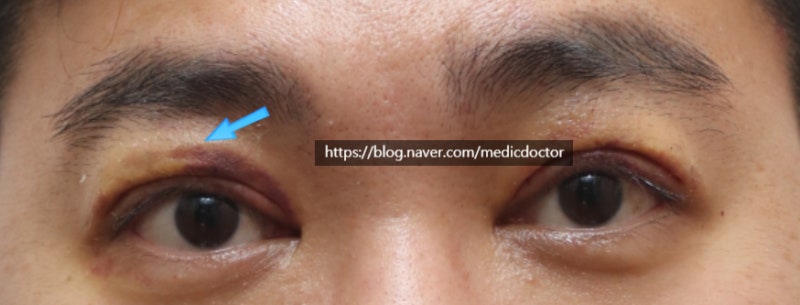
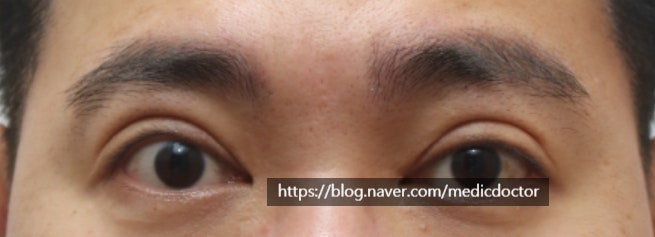
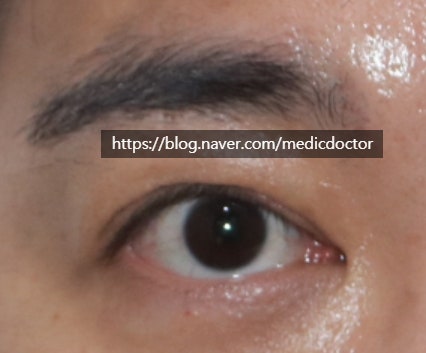
Looking at this patient's eyes, the left side appears relatively normal,
but the right eye is wide open, as if startled.
This is particularly evident when magnified.
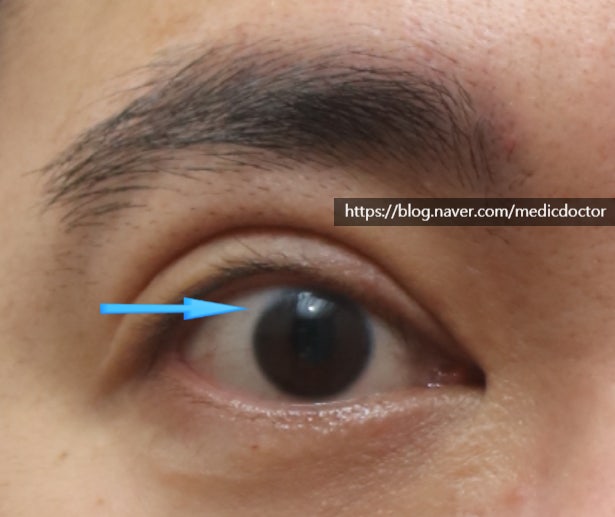
The white of the eye is almost entirely visible.
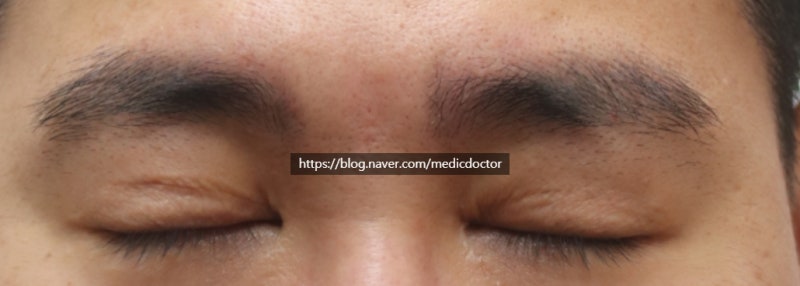
Even when the eyes are closed, severe scarring and an unreasonably high line are visible. This is commonly referred to as a ‘sausage eyelid’.
For men, the vast majority prefer that the double eyelid crease is not visible, only the eye itself.
To achieve this, the line must be lowered, and the skin must cover it from above.
What I mean is,
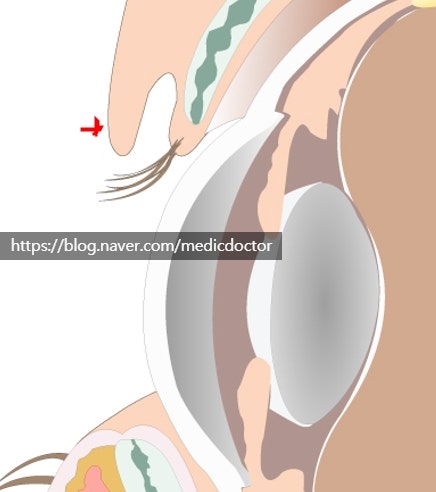
The red shaded area indicates that the skin should cover the front to conceal the double eyelid.
This patient had limited tissue in the upper area and severe scarring, making the likelihood of re-adhesion high.
Various techniques are required to prevent re-adhesion. We used advanced materials, currently being researched with a professor from Korea University, to prevent re-adhesion, and also repositioned fat.
Specifically, re-adhesion is particularly common after ptosis surgery because the levator palpebrae superioris muscle moves upward. This is too specialized a topic, so I will move on.
One week after surgery, the patient's right eye (left eye from our perspective) shows a lowered double eyelid and corrected retraction.
However, this is not the end. Re-adhesion typically occurs well between 2 weeks and 1-2 months.
We anticipated this would happen with this patient. Even in the photo above, a subtle fold from the original line is visible.
We observed the progress at 1 month.
The patient mentioned that if they open their eyes with a little more effort, another fold appears above the line.
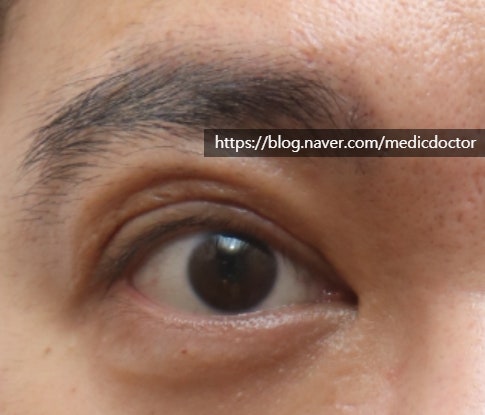
Since we had anticipated this, we reassured the patient and told them that it would improve with time.
This occurs partly due to adhesion in the upper area, but for this patient, it was also due to a slight sunken appearance from lack of volume in the upper area, and the lower double eyelid not settling properly because of residual swelling.
However, most patients who have undergone multiple surgeries experience immense stress about surgical failure and often distrust doctors or worry about another failure.
Nevertheless, this patient trusted me.
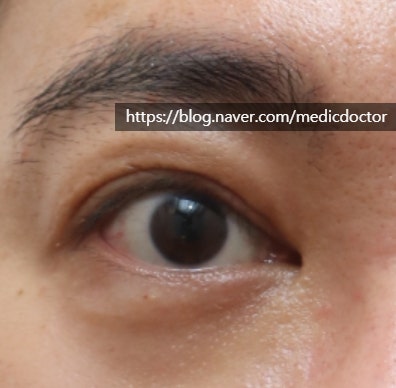
At 3 months, even when the eyes are opened wide, the line does not form prominently. This is because the swelling below the double eyelid line has subsided.
This is the final appearance at 6 months. The line is well lowered, the retraction is well corrected, and no secondary folds have formed.

Again, these photos are of actual patients, unedited with Photoshop or other software, using only Alcapture for image processing.
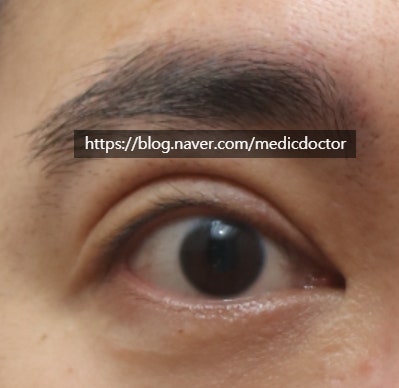
Before surgery, 6 months after surgery
Frequently Asked Questions
How is the double eyelid line corrected during male double eyelid revision surgery?
Yes, typically, we use a method to lower the line so that the double eyelid is not visible. After resetting the line lower, the upper skin covers it, correcting it so that the double eyelid does not show externally, creating a natural eye shape.
Why is re-adhesion common after eyelid retraction surgery?
This is because the levator palpebrae superioris muscle moves upwards. During the process of correcting eyelid retraction, changes in the position of the muscle that opens the eye increase the possibility of re-adhesion, thus requiring meticulous techniques to prevent it.
How can re-adhesion be prevented after double eyelid revision surgery?
Re-adhesion is prevented by using fat repositioning and special materials. If scarring is severe or tissue is insufficient, adhesion can easily occur, so during surgery, materials that act as adhesion preventers are inserted between tissues, and fat repositioning is performed.
Can the original line fold again after a double-line incision surgery?
Yes, in the first 1-2 months after surgery, the original line may temporarily fold due to swelling and lack of volume. However, this phenomenon occurs because the swelling of the lower double eyelid has not subsided, and it usually disappears naturally as the swelling goes down after about 3 months.
When can I see the final results of a double-line incision surgery?
Typically, the final results can be confirmed about 6 months after the surgery. In the first 1-2 months, swelling and subtle multiple folds may be visible, but over time, the swelling completely subsides, and the line stabilizes, completing a natural eye shape.