2026-06-07
Anatomy of Facial Aging: Terminology and Structures - A Post for Plastic Surgeons -
A professional guide to facial aging anatomy, covering the palpebromalar groove, tear trough ligaments, and mid-cheek structures for plastic surgery specialists.
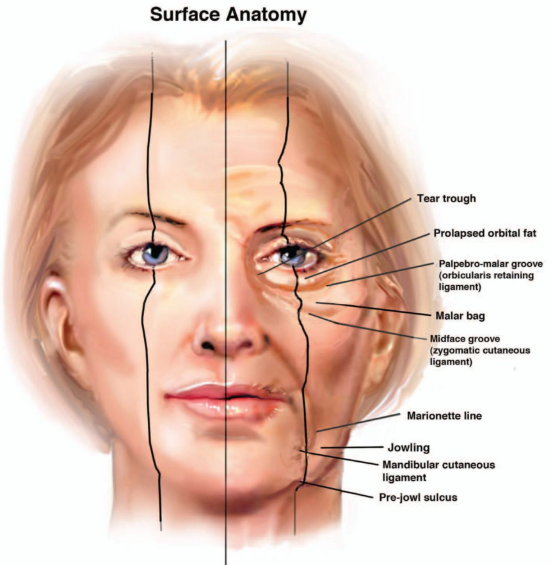
Anatomy of Facial Aging: Terminology and Structures. - A Post for Plastic Surgeons -
Terminology for facial anatomy - These images are primarily sourced from the internet. If there are any copyright issues, please contact me and I will remove them immediately.
Sharing by plastic surgery specialists is welcome; unauthorized scraping is not. If you find any errors, have corrections, or wish to hold an academic discussion, please leave a comment.
The palpebromalar groove area is easily confused because there are so many anatomical structures and terms used to describe it.
Related terms for the vicinity include the lid-cheek junction, tear trough ligament, and the nasojugal groove as it approaches the nose.
Ultimately, the tear trough is synonymous with the nasojugal groove, and the tear trough ligament is the ligament situated beneath it.
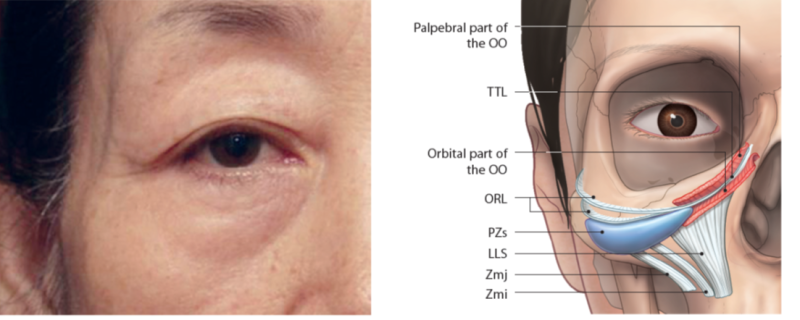
Additionally, the anatomical structure below the palpebromalar groove is the ORL (orbital retaining ligament).
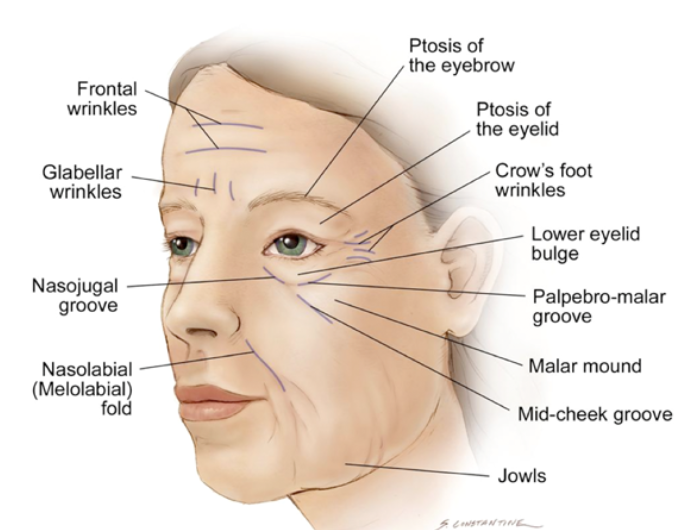
The mid-cheek groove likely corresponds to the ‘Indian band’ and seems to share the same meaning as the mid-face groove. The zygomatic cutaneous ligament appears to be located beneath it.
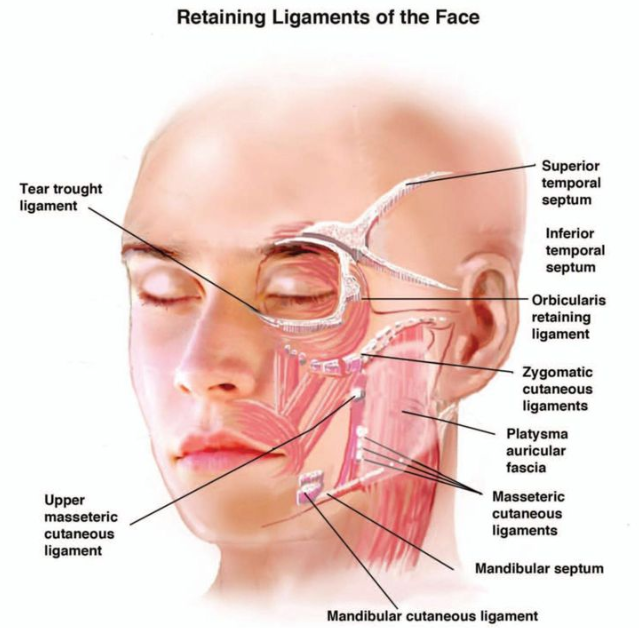
Various ligaments are situated in the deeper layers.
Frequently Asked Questions
Are tear trough and nasojugal groove different areas?
No, the two terms ultimately refer to the same area. According to the anatomical description in the text, the tear trough is identical to the nasojugal groove, and the ligament located beneath it is the tear trough ligament.
What anatomical structures are located below the palpebromalar groove?
Below the palpebromalar groove is an anatomical structure called the ORL (orbital retaining ligament). This is one of the important ligaments discussed in facial aging anatomy.
What is the anatomical name associated with the Indian band?
The Indian band corresponds to the mid-cheek groove. This is used interchangeably with mid-face groove and is primarily mentioned when describing facial aging and anatomical features of the mid-face.
What ligament is located below the mid-cheek groove?
The zygomatic cutaneous ligament is located there. In terms of facial anatomical structure, various ligaments, including this one, are present below the mid-cheek groove (Indian band).