2026-05-29
Misconceptions About Double-Fold Lowering (Skin-Sparing) Scars, Low Crease Scars, and Incisional Double Eyelid Scars (feat. Deep Fixation?)
A professional guide clarifying misconceptions about scarring and 'deep fixation' in double eyelid lowering surgery, explaining why temporary skin folds occur and how scars heal over time.
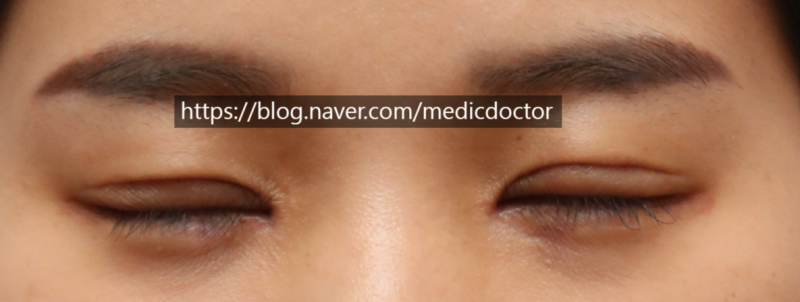
Misconceptions About Double-Fold Lowering (Skin-Sparing) Scars, Low Crease Scars, and Incisional Double Eyelid Scars (feat. Deep Fixation?)
The title is quite grand. While following up and consulting with patients recently, I felt a post on this topic was necessary. I promised a patient I would create this, so I must keep my word. ^^
When performing the procedure commonly known as ‘double-fold lowering’ (Dujulttagi), we often lower the line significantly.
First and foremost, Gangnam Seoyeon Plastic Surgery does not use deep fixation.
For more details on the double-fold lowering technique, please refer to my previous post.
https://blog.naver.com/medicdoctor/221353621318
When lowering the line, there are cases where patients request the double eyelid to be almost invisible.
This is particularly common among men, and occasionally among women as well.
Let’s look at an example of double-fold lowering where the patient wanted the crease lowered to look like an ‘inner double eyelid’ (hidden fold).
This is the appearance one week after surgery. You can see a slight bulge above the incision line.
When patients see this step-like difference, the most common misconception they have is thinking, ‘The fixation is too deep.’
This is not due to deep fixation.
Oh? Then what is it?
It is due to two main reasons.
1. First, it is a surgical technique. Double-fold lowering often results in triple folds (multiple creases). Therefore, if a surgeon lacks experience or to prevent failure, they put a ‘safety mechanism’ in place to prevent these common triple folds.
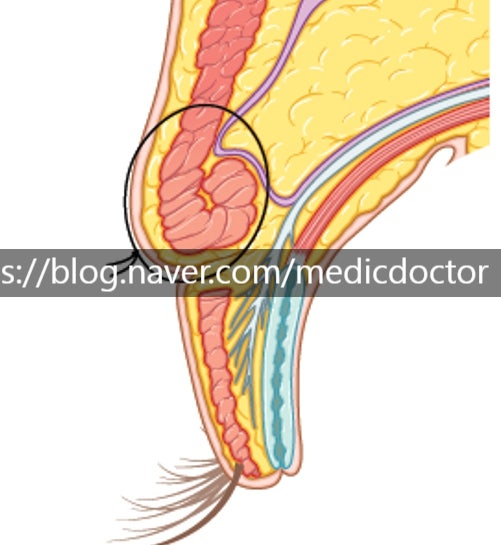
This specific technique acts as a device to block triple folds. As those who know me are aware, I rarely apply tape over the eyes after surgery. I only do so in very rare cases where the skin is extremely thin or in special circumstances.
2. Second, even if the crease is set low, if there is a lack of skin, the double eyelid will inevitably show. To make the crease invisible, skin must be left above to cover it.
What does this mean?
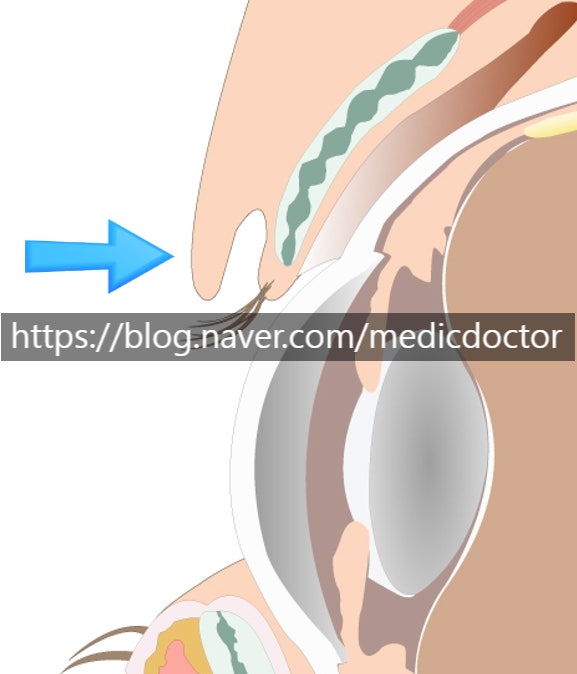
It is because the skin indicated by the arrow was left above the incision line. The illustration above is excerpted from my paper on ‘Monolid Ptosis Correction,’ which was the first of its kind published in the American Aesthetic Surgery Journal in 2018.
https://blog.naver.com/medicdoctor/221345077605
Let’s look at the following video.
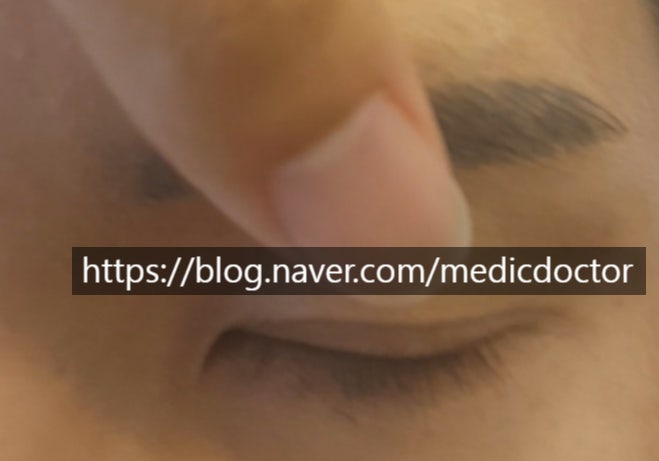
In this scene when the eyes are closed, the folded part you see is not a scar; it is the skin left above the incision line intended to cover the crease when the eyes are open.
If you dislike this look, we could cut away the covering skin, but then the double eyelid would be visible. The line would not be as low as desired. Furthermore, it is generally better to raise the line slightly rather than cutting skin away.
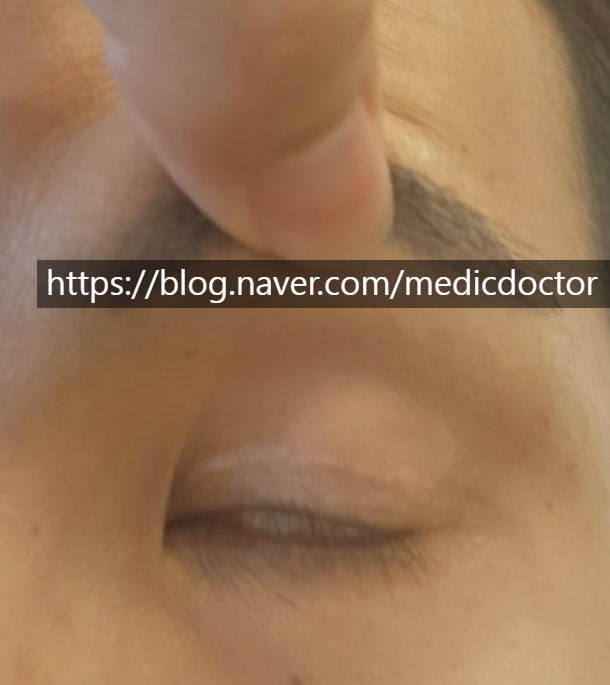
Instead, if you pull the skin taut, it looks like a faint, flat line. The white substance seen in the fold is just sunscreen the patient applied.
I hope this clears up the misunderstanding about fixation.
When plastic surgeons talk about ‘deep fixation,’ it doesn’t look like this.
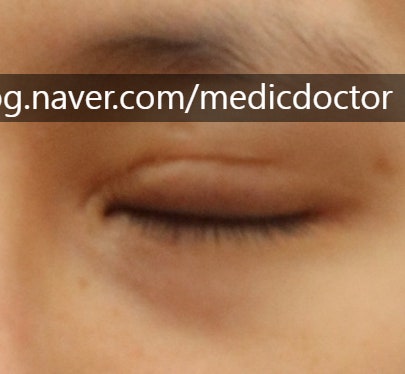
This kind of pitted scar is what we call deep fixation.
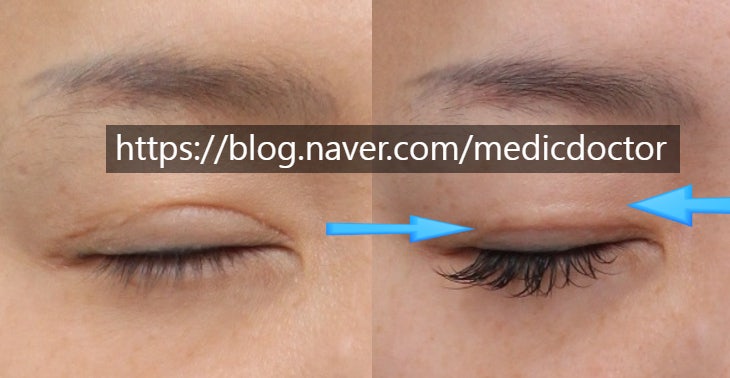
The ‘pinched’ look on the left was lowered using the double-fold lowering technique on the right, while also improving the scar as much as possible. The top arrow points to the new crease, and the bottom arrow points to the old scar.
Our clinic minimizes scarring through shallow fixation.
For your information, the folded area mentioned earlier will flatten out more as time passes.
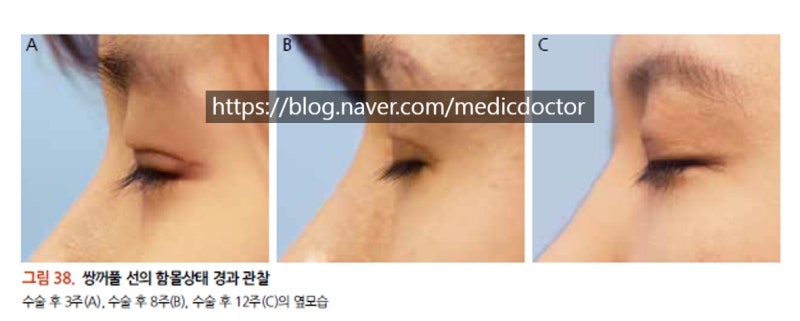
This photo is taken from our Aesthetic Plastic Surgery textbook (Gunja Publishing). Even sunken marks flatten over time. However, as explained, if the line is lowered significantly, the skin will appear to overlap the incision line. Also, protruding eyes tend to look flatter, while recessed eyes tend to have more skin coverage.
Without knowing these details, it is easy for novice doctors or general patients to misunderstand the results.
As a side note, regular incisional double eyelid scars can also look uneven or protrude in the early stages.
They may look worse for up to 3 months but will improve after 6 months.
Evaluating a scar at the one-month mark is simply not realistic... ㅠㅠ
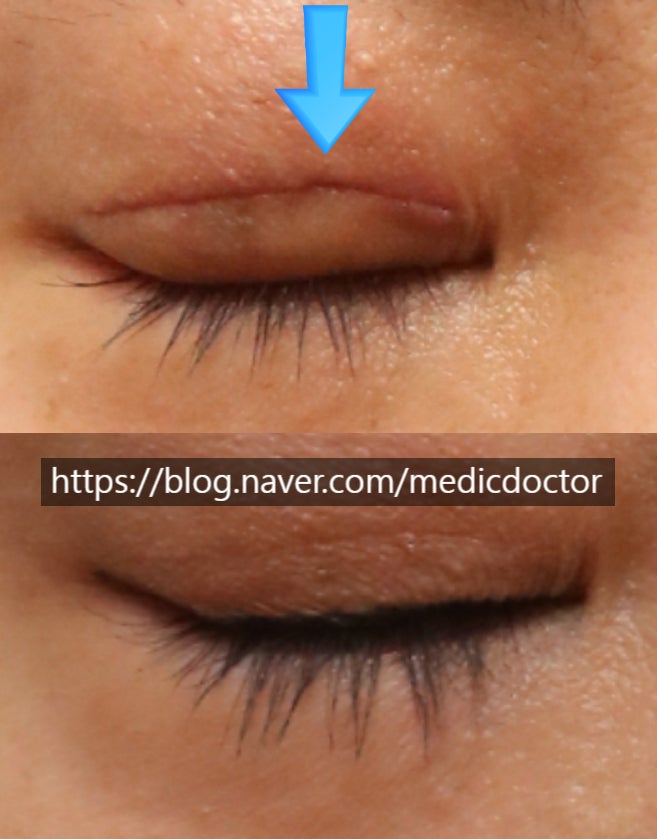
Even if the incision scar looks angled at the arrow, it will settle naturally on its own without any intervention.
Revision surgery patients always come to me asking to ‘remove’ their scars.
While scars can be improved, they do not disappear. You must understand that severe existing scars can get better but will never be completely gone. I always remind patients that while we can improve the scar, it won’t vanish. The priority is looking beautiful when the eyes are open, and I want you to know I do my absolute best with the scarring. An incision naturally creates a scar. I strive to make it as invisible as possible, like the patient above. However, demanding no scar at all is too harsh. Constitutional factors play a role, and since we don’t know the internal condition beforehand, 100% scar removal cannot be guaranteed. I simply give my best effort.
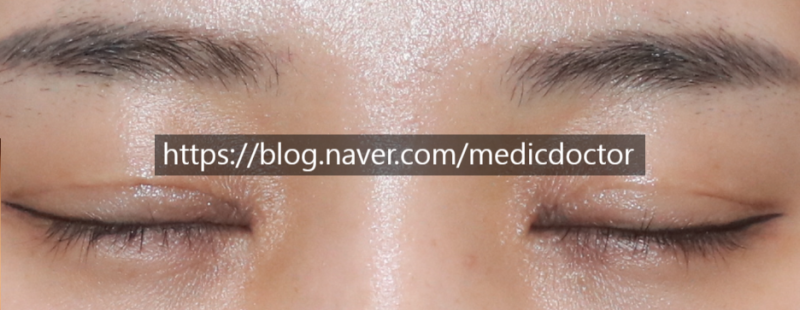
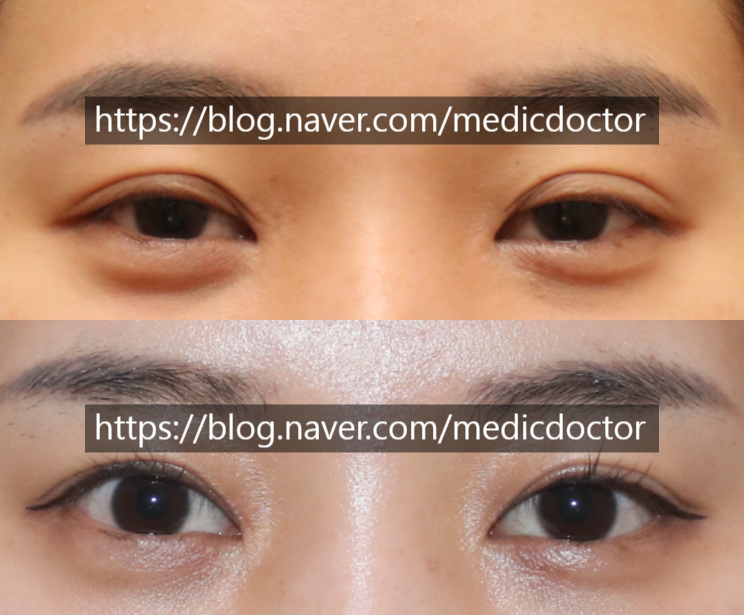
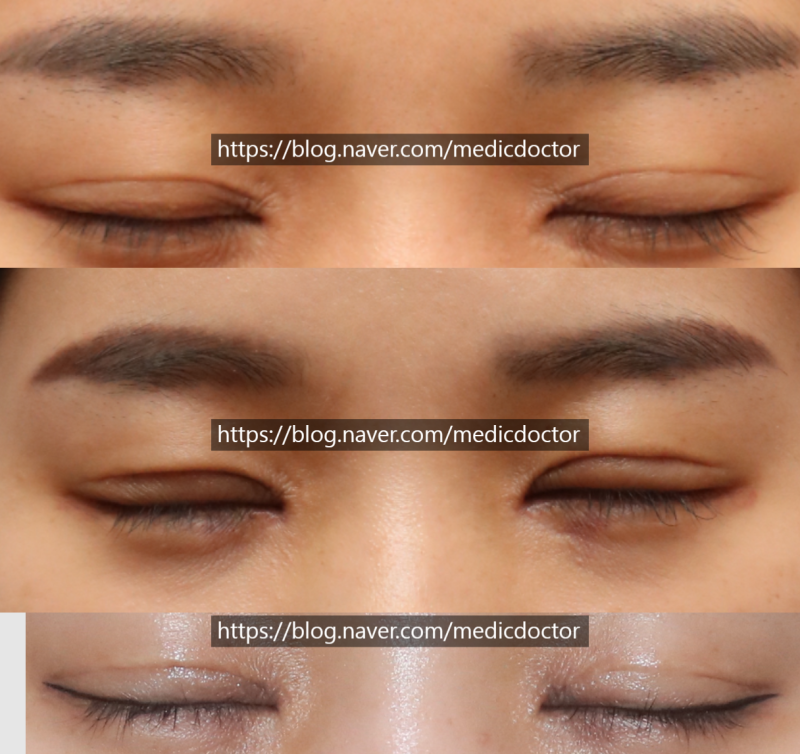
Before surgery, 3 years after surgery (eyes closed), and 3 years after surgery (eyes open).