2026-05-29
Eyelid Retraction Correction Methods (feat. Double-Line Incision)
Learn about eyelid retraction correction and how it can be combined with double-line incision techniques to fix over-exposed eyes and high creases.
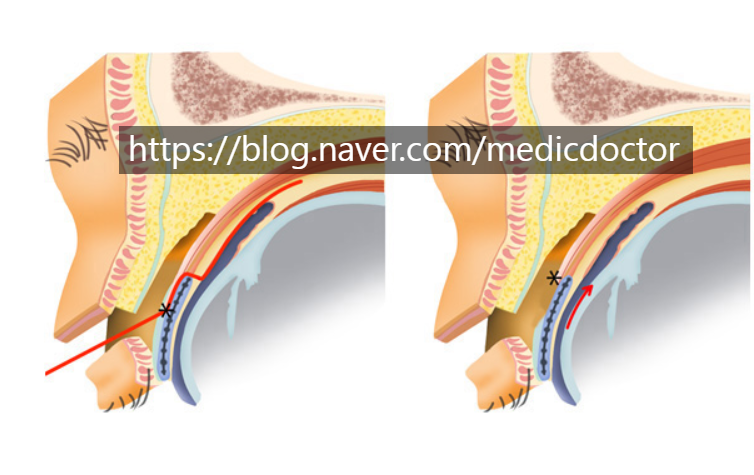
Eyelid Retraction Correction Methods (feat. Double-Line Incision)
In this post, I will discuss the methods used for eyelid retraction correction.
First, we need to understand what eyelid retraction is. To do that, we should look at the normal position of the eyelid.
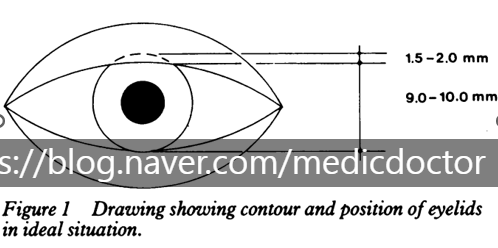
In a normal eye, the upper eyelid should slightly cover the top of the iris, typically by about 1 to 2mm.
When it does not,
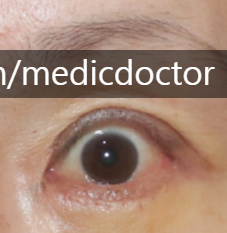
and the eye appears excessively open like this, we use the term ‘eyelid retraction’.
Pathological causes for this condition often include hyperthyroidism (Graves’ disease) or, in rare cases, congenital factors.
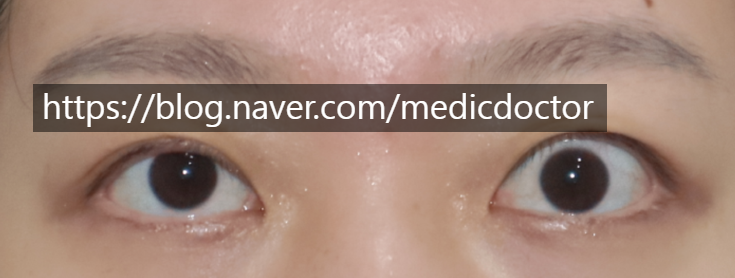
There are cases like this patient, who has never had surgery before but still exhibits an over-opened eye.
Today’s case involves a patient who underwent surgery last year and recently returned for a one-year follow-up.
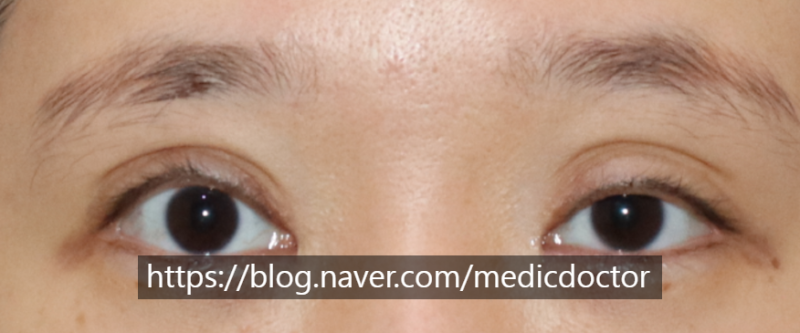
One eye is in a retracted state, opening excessively with multiple folds, while the other eye has multiple folds but appears relatively smaller.
Correction is only possible by completely separating the levator muscle just above the tarsal plate and releasing all adhesions connected down to the conjunctiva.
This is not a problem that can be solved simply by removing ptosis correction sutures. Please refer to my previous post for more details.
https://blog.naver.com/medicdoctor/222790575523
Additionally, we performed a ‘double-line incision’ (Dujul-ttagi) to lower the crease line.
Lowering the crease while performing retraction surgery is relatively difficult. There is a high risk of triple folds occurring, so one must be prepared for all possible scenarios beforehand.
For this patient, we only performed the line lowering and retraction correction without any fat grafting.
Some patients believe that fat grafting is mandatory for double-line incisions, or that ptosis correction must be performed. However, achieving the result without either of those requires much higher technical skill.
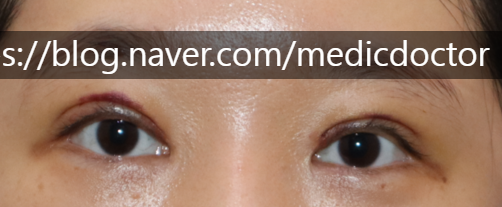
This is the appearance at 1 week post-op.
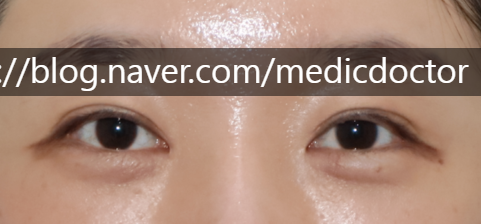
This is the appearance at 1 year post-op.
I am very proud of the successful outcome, and it makes me happy to see that the patient is also very satisfied.
https://youtu.be/TeMZvKnIeF4
Frequently Asked Questions
What is eyelid retraction?
Eyelid retraction is a condition where the eyelid is excessively open, exposing more of the eyeball than normal. Normally, a healthy eye covers about 1-2mm of the iris, but with eyelid retraction, the eye opens much wider than this. It can be caused by hyperthyroidism or congenital factors.
How is eyelid retraction surgery performed?
Eyelid retraction surgery involves detaching all muscles that open the eye just above the tarsal plate and completely releasing adhesions connected to the conjunctival side. It is not simply a matter of removing the previous ptosis correction sutures, but requires precise dissection.
Can eyelid retraction surgery and double-line revision be performed together?
Yes, it is possible. However, performing double-line revision to lower the double eyelid line concurrently with retraction surgery is relatively difficult due to the risk of creating multiple folds. Therefore, skilled techniques capable of handling various cases are required.
Is fat grafting or ptosis correction always necessary for double-line revision surgery?
No, it is not always necessary. As shown in the case examples, double-line revision and eyelid retraction surgery can be successfully performed without adding fat grafting or ptosis correction. In fact, performing the surgery without these two procedures requires even higher technical skill.