2026-05-29
Double Eyelid Revision: Before, Immediately After, and 1-Week Post-Op Video Review for Multiple Creases (Triple Eyelids)
This article details a double eyelid revision for multiple creases (triple eyelids), including before, immediately after, and 1-week post-op video reviews.
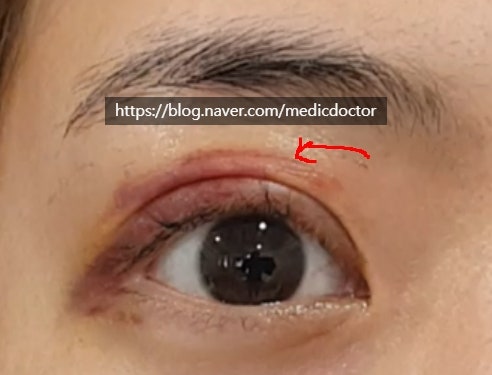
I have titled this article as follows:
Double Eyelid Revision: Before, Immediately After, and 1-Week Post-Op Video Review for Multiple Creases (Triple Eyelids)
This patient found our hospital through an online search. While most of our patients are referred, we occasionally have those who find us through search engines.
The patient mentioned that after their initial surgery, they had a double eyelid crease along the incision line.
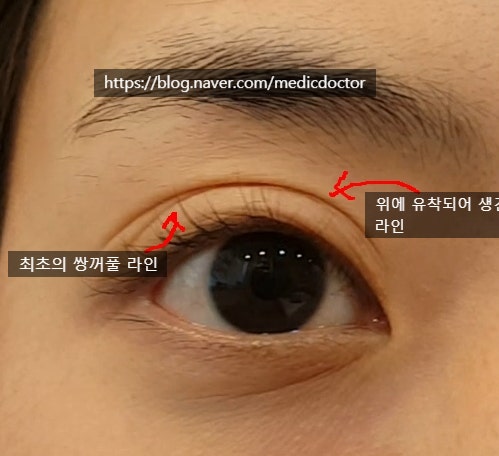
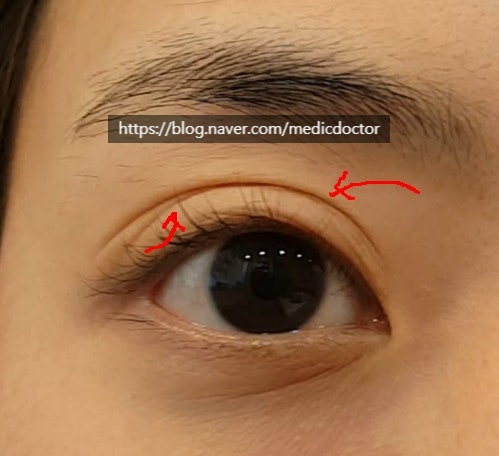
The upper arrow indicates the line formed by an adhesion above, and the lower arrow points to the original incision line for the double eyelid.
So, the double eyelid did not form where it was initially operated on, nor did it form at the incision site, but rather above it.
This is a case where there is strong adhesion internally, coupled with a lack of volume. This results in a ‘sausage’ double eyelid appearance.
‘Sausage’ double eyelid? However you prefer to spell it…
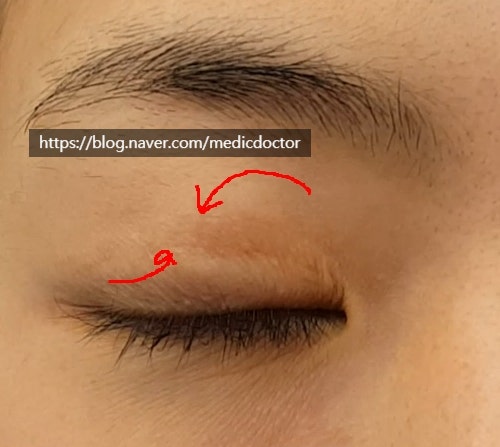
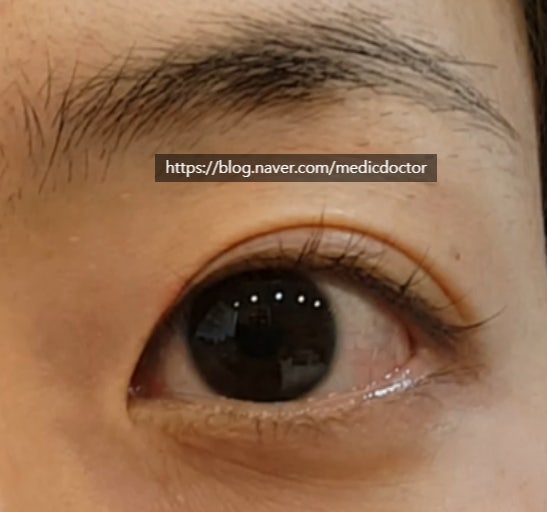
The opposite eye has a well-formed double eyelid crease along the incision line.
The revision plan is to create a smooth crease again and to slightly enhance the visibility of the front part of the opposite eye's crease.
While it is sometimes possible to operate on only one eye, in such cases, my personal opinion is that if the same surgeon is performing the line correction, operating on one side might be an option. However, if different surgeons performed the initial surgeries, there could be differences in surgical methods, so I recommend re-operating on both sides.
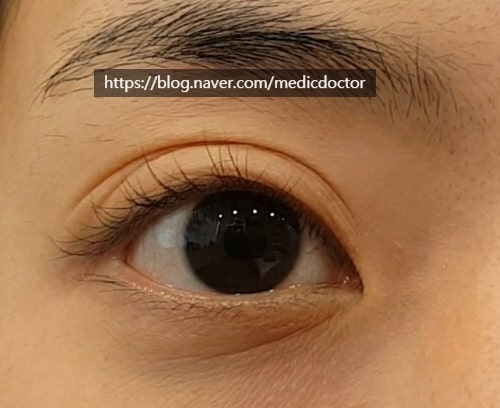
This photo does not have arrows.
The surgical plan is to prevent re-adhesion in the area where the upper crease forms, while also reinforcing volume.
Referring to a lecture I gave at a conference previously:
https://blog.naver.com/medicdoctor/221353621318
This is part of a lecture I was invited to give at the Department of Plastic Surgery, Dongguk University in 2016.

Let's assume a thick board, a thin piece of paper, and corrugated cardboard are glued side-by-side. If you try to fold them, the corrugated cardboard is stiff, so the fold will naturally occur in the thin skin.
However, let's assume on the right side, one thin piece of paper, another thin piece of paper, and corrugated cardboard are glued together. The corrugated cardboard won't fold because it's stiff, but the upper thin paper part can fold either at the top or in the middle paper section.
What we commonly refer to as a double eyelid is like corrugated cardboard – A4 paper – corrugated cardboard. The double eyelid is supposed to fold at the appropriate part where the A4 paper is, with the upper corrugated cardboard being near the eyebrow and the lower corrugated cardboard near the eyelashes.
In other words, if the skin near the eyebrow is thin and has adhesions there, it can cause triple eyelids like this.
I believe this information would be useful for any plastic surgeons who might be studying this content.
The key points of the surgery are three: upper volume augmentation, adhesion dissection, and prevention of re-adhesion.
Adhesions were dissected, and volume was augmented in the upper area (below the eyebrow).
This is the appearance at 1 week.
The correction was successful. The patient had one question.
She felt like another crease was forming above. For a moment, I worried if it was re-adhesion, but re-adhesion rarely occurs in experienced hands.
I will explain what this is with an illustration.
As some of you may have noticed, if a crease has been present for a long time, it can leave a slight trace, like a wrinkle.
This isn't a failure to correct the triple eyelid; rather, if the skin has been folded for a long time, that area can remain slightly wrinkled.
If you look at people with naturally small eyes, they often use their forehead for a long time, and such individuals have deep forehead wrinkles.
So, after addressing ptosis or skin laxity, they stop using their forehead, but the forehead wrinkles remain.
However, in younger individuals, over time, these wrinkles become very faint, to the point of being unnoticeable.
It's been one week immediately after stitch removal, and a single line of bruising makes it appear more prominent. There is absolutely no need to worry.
I will upload additional information when the patient comes for their follow-up visit.
Frequently Asked Questions
Why do triple eyelids (multiple folds) occur?
Yes, they mainly occur due to strong internal adhesion and lack of volume in the upper part of the eye. Adhesion occurs in the thinner skin above the existing incision line, creating an unwanted extra line that makes it look like a sausage eyelid.
What is the core of the double-line revision surgery to fix multiple folds?
The core of the surgery involves three things: upper volume augmentation, adhesion dissection, and prevention of re-adhesion. It releases the existing strong adhesion in the wrong place and fills the empty space under the eyebrow with volume to prevent multiple folds from recurring.
I have multiple folds in only one eye, do I need to revise both eyes?
Yes, if the surgeon is different, it is recommended to operate on both sides together. Although it is possible to correct only one eye, there may be methodological differences from the previous surgery, so it is advantageous to re-align both lines smoothly for symmetry and completeness.
It's been one week since my double-line revision surgery, and the old line is faintly visible. Is it re-adhesion?
No, this is not re-adhesion, but a simple wrinkle caused by the skin being folded for a long time. It's the same principle as wrinkles remaining when you use your forehead for a long time to open your eyes, and over time, it becomes very faint and natural to the point of being difficult to perceive.