2026-05-29
Eyelid Retraction Surgery Case Study: 1-Week Post-Op (Unilateral Surgery)
A case study of a patient who underwent eyelid retraction surgery on only one side to correct asymmetry and overcorrection from previous surgeries.
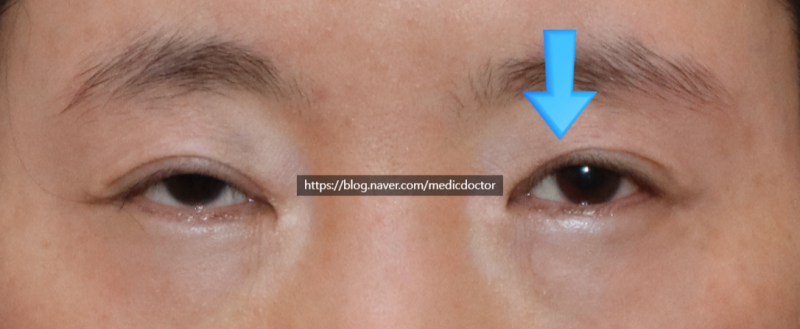
Eyelid Retraction Surgery Case Study: 1-Week Post-Op (Unilateral Surgery)
This post focuses on a specific case of unilateral eyelid retraction surgery.
Generally, when performing retraction surgery or ptosis correction, the standard principle is to operate on both sides to achieve better symmetry.
However, there are occasional cases where surgery is performed on only one side.
Personally, I opt for unilateral surgery in the following situations:
- When performing early correction after a bilateral surgery
- When adjusting asymmetry during a follow-up (A/S) procedure
- When achieving perfect symmetry is inherently difficult regardless of the approach
In this patient’s case, the eye on the right side of the photo (the patient’s left eye) opens wider, which caused the patient to feel discomfort in the eye on the left side of the photo (the patient’s right eye).
However, the patient requested surgery only on the right side of the photo (the patient’s left eye). This was based on the expectation that Hering’s Law—which affects the contralateral eye—might help balance the eye sizes symmetrically.
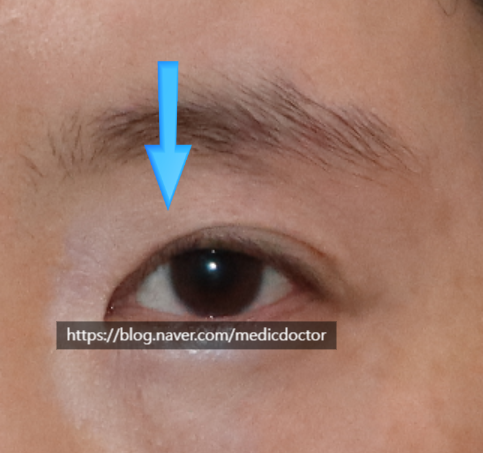
This is a magnified photo taken from a different angle. The patient noted that the inner corner (anterior portion) appeared slightly more retracted, looking overcorrected. This is the area indicated by the arrow.
Looking at the pre-operative state in the video, it is clear that one eye opens significantly wider and does not close completely.
While retraction due to ptosis overcorrection can prevent the eye from closing, in this case, the inability to close fully is due to the effects of repeated surgeries.
Immediately after surgery, there is some swelling and the eye may appear slightly large, but it typically settles into place as the swelling subsides.
This is the appearance 1 week after surgery. The eyes have become much more similar in size.
The swelling of the double eyelid fold itself will take more time to resolve, and the degree of eye closure will return to the patient’s baseline level.
We plan to continue monitoring the progress consistently.
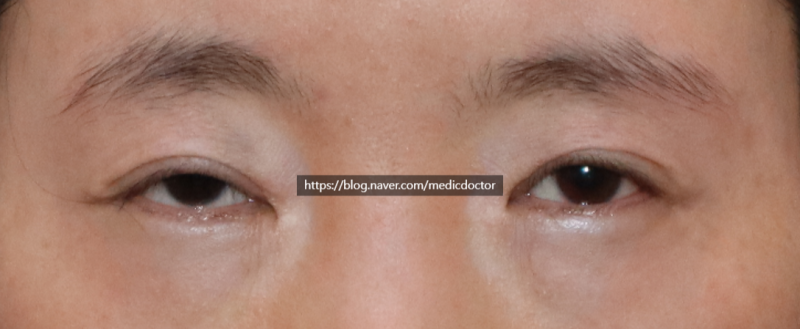
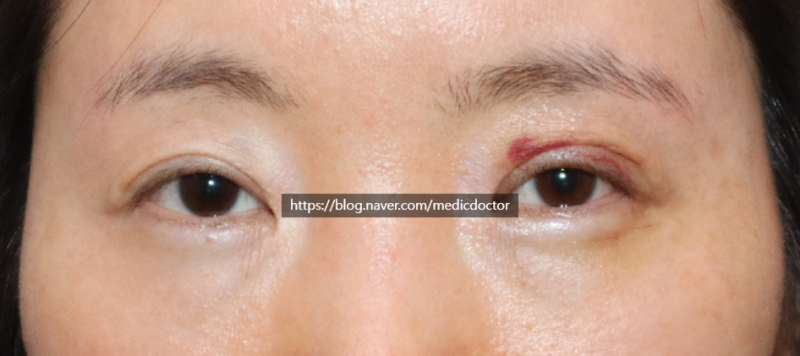
These are the pre-operative and post-operative images.
The surgery appears to have been successful.
Frequently Asked Questions
Is it mandatory to perform eyelid retraction surgery on both eyes?
No, it is not mandatory to operate on both eyes. While the principle is to operate on both sides for symmetry, in cases requiring early correction, asymmetry correction, or when perfect symmetry is difficult to achieve, surgery may be performed on only one side.
Can symmetry be achieved in both eyes even if only one eye is operated on?
Yes, symmetry can be achieved. According to Hering's Law, changes in one eye affect the other, so it is possible to achieve a certain degree of symmetry in the size of both eyes with eyelid retraction surgery on only one eye.
Why did the symptom of incomplete eye closure occur before surgery?
It could be due to retraction caused by overcorrection during ptosis correction, but in this case, the symptom of incomplete eye closure occurred due to repeated eye surgeries.
What is the progress immediately after and one week after retraction surgery?
Immediately after surgery, there may be slight swelling and the eyes might appear a bit larger. However, after one week, as the swelling subsides, the size of both eyes becomes much more similar. More time is needed for the swelling of the double eyelid itself to completely disappear.
What happens to the symptom of incomplete eye closure after surgery?
The symptom of incomplete eye closure after surgery will return to the previous state over time. The medical team will continuously monitor the progress to confirm the recovery process.