2026-05-29
Undoing Incisional Ptosis Correction: Early Revision for Complication Prevention
Learn why early revision is crucial for correcting overcorrection or asymmetry after incisional ptosis surgery to prevent long-term complications and reduce stress.
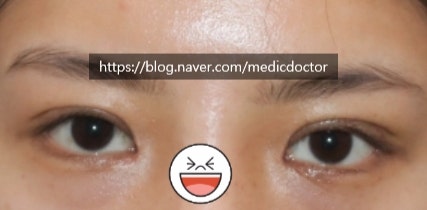
Undoing Incisional Ptosis Correction: Early Revision (Complication Prevention) - Source: Choi Dong-il’s Blog
When performing incisional ptosis correction, the most critical factors to watch for are overcorrection, undercorrection, and asymmetry.
Consequently, there are cases where incisional ptosis correction must be adjusted early. This post introduces cases where the incisional ptosis correction is undone or loosened.
Early revision surgery is significantly helpful in preventing complications and is a method that greatly reduces stress for both the patient and the surgeon.
Usually, even if asymmetry appears well-corrected immediately after surgery, factors such as local anesthesia can lead to one side becoming overcorrected or undercorrected as time passes.
The photo below shows a case where one eye appears overcorrected. This is the process of slightly loosening the ptosis correction.
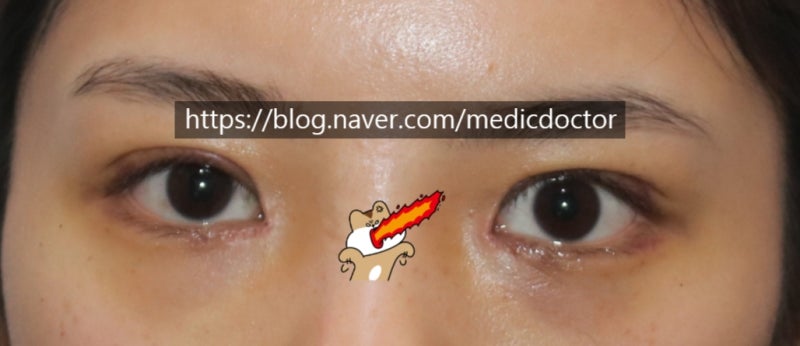
Let’s look at the patient’s left eye in this image.
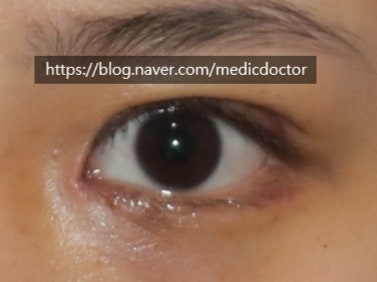
If one side is overcorrected like this after surgery, it is better to perform an early revision rather than just waiting blindly.
Typically, if a difference is noticeable when stitches are removed around 1 week post-op, the correction can be done immediately. In other cases, it may be performed around 2 weeks post-op once more swelling has subsided.
Correction is easily achieved if the ptosis correction points are properly repositioned.
However, if the condition has persisted for a long time, the surgical method changes entirely.
All adhesions must be released.
The issue can only be resolved by releasing all adhesions involving the levator aponeurosis, Müller’s muscle, and the conjunctiva.
The surgery usually takes about an hour.
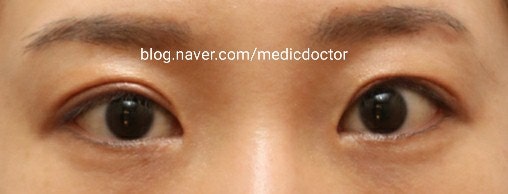
One side appears overcorrected.
This is a patient who is more than 6 months post-op.
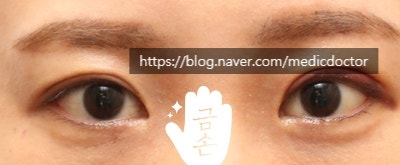
The overcorrected portion has been resolved.
In cases where overcorrection has persisted for a long time, the procedure should be performed by an experienced plastic surgeon to minimize complications as much as possible.
Frequently Asked Questions
When should I undergo revision surgery if overcorrection occurs after incisional ptosis correction?
It is best to perform early correction within 1-2 weeks after surgery. If you proceed immediately at the 1-week mark when the stitches are removed, or around 2 weeks when some swelling has subsided, a quick revision surgery can readjust the ptosis correction points, making correction relatively easy.
I have asymmetry after ptosis correction; should I just wait indefinitely?
No, it is not advisable to wait indefinitely. Immediately after surgery, asymmetry may not be clearly visible due to anesthesia, but if obvious overcorrection or asymmetry is observed after 1 week, early correction is recommended to prevent complications and reduce stress.
Can overcorrection that occurred 6 months ago still be reversed?
Yes, it is possible, but the surgical method will be completely different. In older cases, all adhesions formed in the levator aponeurosis, Müller's muscle, and conjunctiva must be released for resolution, and the surgery typically takes about 1 hour.
What should I be aware of when undergoing surgery to reverse old ptosis correction?
It is most important to have the surgery performed by an experienced plastic surgeon. A complex process is required to meticulously release all adhered tissues, so the diagnosis and execution by a skilled medical team are essential to minimize complications.