2026-05-29
Correcting Uneven Eyes: Case Study on Ptosis Correction for Asymmetrical Eyelids
A clinical look at correcting asymmetrical eyes using ptosis correction and fat grafting, addressing skeletal issues and Hering’s Law.
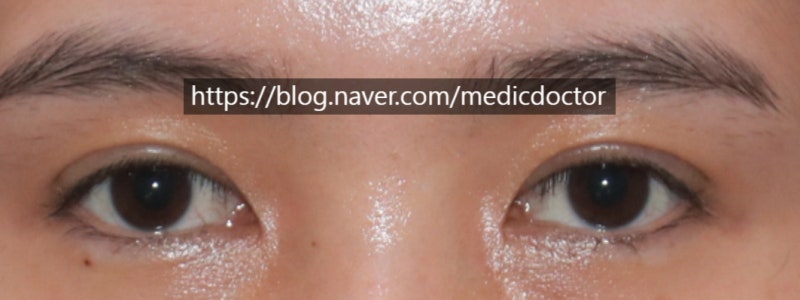
Correcting Uneven Eyes: Case Study on Ptosis Correction for Asymmetrical Eyelids
It has been a while since my last post.
Occasionally, we encounter cases where uneven eye correction is necessary due to facial asymmetry or when one eye is noticeably smaller than the other.
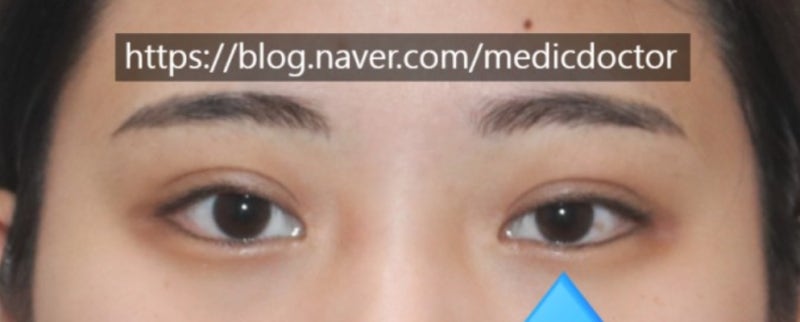
In this patient’s case, the left eye is smaller than the opposite side. (Indicated by the arrow on the right side of the photo.)
In such instances, we strive to achieve symmetry through ptosis correction surgery.
However, if the eyes themselves differ due to skeletal variations caused by facial asymmetry, perfect correction can be challenging.
This is because it is difficult to fully compensate for skeletal asymmetry using only soft tissue.
Nevertheless, we can use ptosis correction surgery to make them look as similar as possible.
Sometimes, ‘Hering’s Law’ may cause the opposite eye to appear smaller after surgery. In these cases, it is crucial to determine which eye is the ‘Dominant eye’ before proceeding.
Of course, I perform these examinations personally, so there is no need for concern.
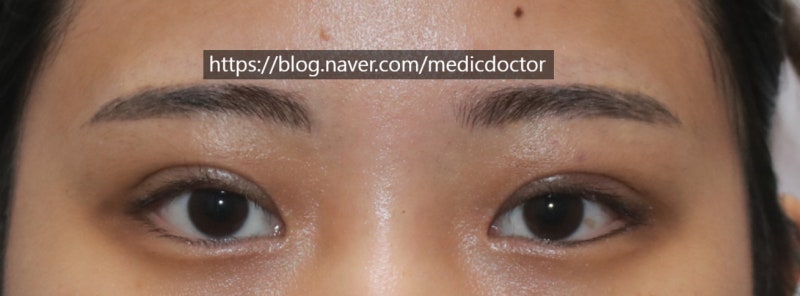
Although there is still some swelling as it is only one week post-op, the left-right symmetry has improved significantly. This patient underwent ptosis correction on only one side (the right side of the photo, which is the patient’s left eye).
Sometimes, asymmetry is caused by fat distribution.
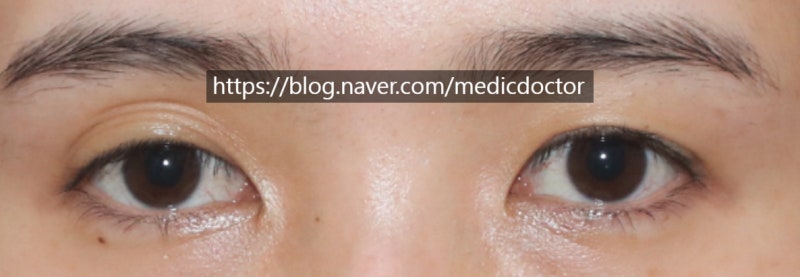
The patient’s right eye (left side of the photo) looks different because the fat appears sunken.
In this case, double eyelid surgery was performed in conjunction with fat grafting.
The key technique in fat grafting is ensuring the area does not feel lumpy. Since it can sometimes be felt in individuals with thin skin, I recommend a conservative approach, injecting only a small amount.
At one month post-op, the symmetry appears to be well-balanced.
Correcting uneven eyes involves a wide variety of cases and numerous variables. I will introduce more cases when the opportunity arises.
This post was written based on a lecture I gave at the Korean Society of Plastic and Reconstructive Surgeons in November 2021.
Frequently Asked Questions
Can perfect symmetry be achieved with asymmetric eye correction (ptosis correction)?
Perfect correction may be difficult. This is because if the cause of asymmetric eyes is skeletal differences due to facial asymmetry, there are limitations to eye correction that only adjusts soft tissues. However, surgery can improve symmetry to make both eyes appear as similar as possible.
Is it possible to perform surgery on only one eye for asymmetric eye correction?
Yes, it is possible. As shown in the case study, there are cases where eye correction is performed only on one eye, which is relatively smaller, to balance both eyes and achieve left-right symmetry.
Can the opposite eye become smaller after eye correction?
Yes, occasionally the opposite eye may appear smaller due to Hering's law. To prevent this, it is necessary to accurately examine and determine which eye is the dominant eye before proceeding with the surgery.
How is asymmetric eye corrected when the eyelid fat is sunken?
It is corrected by combining upper eyelid fat grafting and double eyelid surgery. Fat is filled into the sunken area to achieve symmetry, and at this time, precise grafting techniques are required to ensure it does not feel lumpy on the skin surface.
What should be noted when performing upper eyelid fat grafting?
People with thin skin should be careful as the grafted fat may be palpable on the surface. Therefore, it is recommended to inject only a small amount of fat conservatively rather than excessively.