2026-06-07
ELS Financial Investment - Preparing for a Rainy Day
A simple guide to Equity-Linked Securities (ELS) investment, explaining underlying assets, early redemption, and the risks of knock-in barriers.

ELS Financial Investment - Preparing for a Rainy Day
Yesterday, while chatting with my beautiful English tutor (refer to previous posts) about investing for a ‘rainy day’, I suddenly felt like writing this post.


It is called ELS (Equity-Linked Securities), and it sounds like a headache already. I will skip the jargon and explain it simply.
There is something called an ‘underlying asset’. Usually, it is index-linked (Kospi 200, EuroStoxx 50, HSCEI, etc.) or individual stocks (Samsung Electronics, Hyundai Heavy Industries, etc.).
Returns are determined based on whether the stock market rises for these underlying assets. However, it does not mean that if the KOSPI goes from 2,000 to 3,000, you get a 30% return.
What I mean is that ELS has a maturity date. A 3-year maturity is the most common, but there are 5-year ones too. And there are opportunities for ‘early redemption’ every 3 months, 6 months, or 1 year.
It is probably faster to give an example, right?
This is an article I just searched for online. I have excerpted part of it; if there is an issue, please contact me and I will delete it. This blog is not commercial at all.
http://news.mt.co.kr/mtview.php?no=2018091209152953407
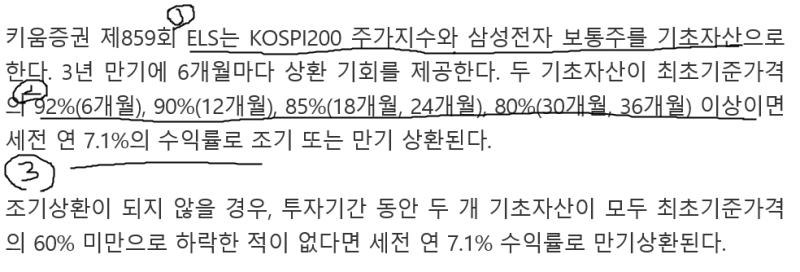
In the example above, ‘1’ refers to the underlying asset used for judgment. For instance, if Samsung Electronics is currently 10,000 KRW and stays above 9,000 KRW until the 12th month, the product is terminated with an annual return of 7.1%, paying out the interest.
Since bank interest rates are around 1.8% these days, isn’t that quite high?
However, if the stock drops to 8,800 KRW at the 12th month, redemption does not happen, and you enter ‘HODL’ mode. -_-;

Still, if it stays above 8,000 KRW by the 3rd year, you get your money back with 7.1% annual interest for those 3 years, so it can be a very good deal.

However, looking at point number 3, if early redemption doesn’t happen, what is that 60%? That is the ‘Knock-in barrier’.
If the stock price falls below 6,000 KRW even once, there is a risk of losing your principal.
For example, if Samsung Electronics stock is 5,000 KRW at the 3-year mark, you would lose 50% of your investment.

During the Lehman Brothers crisis... many people suffered ELS losses...
So you must judge carefully before investing.

I am being serious here... the decision is yours, so don’t blame me if you lose money.
Frequently Asked Questions
What is ELS investment?
ELS stands for Equity-Linked Securities. It is a financial product that uses indices like KOSPI200 or Eurostoxx50, or individual stocks like Samsung Electronics, as underlying assets, and its return rate is determined by the price fluctuations of these assets.
What is the typical maturity of ELS products?
Typically, products with a 3-year maturity are the most common, and 5-year maturity products also exist. Additionally, even before maturity, there are opportunities for early redemption if the underlying asset's price meets certain conditions at 3-month, 6-month, or 1-year intervals.
What happens if the early redemption conditions are not met?
If the early redemption conditions are not met, the investment continues until the next evaluation date. If the underlying asset maintains above the predetermined downside protection level until the 3-year maturity, you can receive your principal back along with 3 years' worth of interest, according to the agreed annual return rate.
Can principal loss occur when investing in ELS?
Yes, principal loss can occur. If the underlying asset's price falls even once below the knock-in barrier set for the product, there is a risk of losing a significant portion of the investment amount depending on the asset price at maturity.