2026-05-29
Severe Ptosis, Advanced Ptosis, and Conjoint Fascial Sheath (CFS) Surgery
Learn about Conjoint Fascial Sheath (CFS) surgery, a specialized technique for severe or congenital ptosis that cannot be corrected by standard ptosis repair.
Severe Ptosis, Advanced Ptosis, and Conjoint Fascial Sheath (CFS) Surgery
Let’s take a closer look at this procedure.
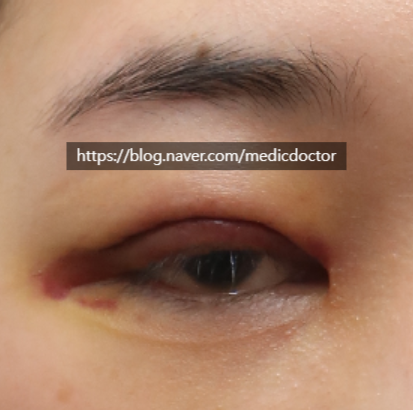
Some people are born with eyes that look extremely sleepy and have difficulty opening properly. In these cases, the eyes often fail to open wider even after undergoing standard ptosis correction (eye shape correction).
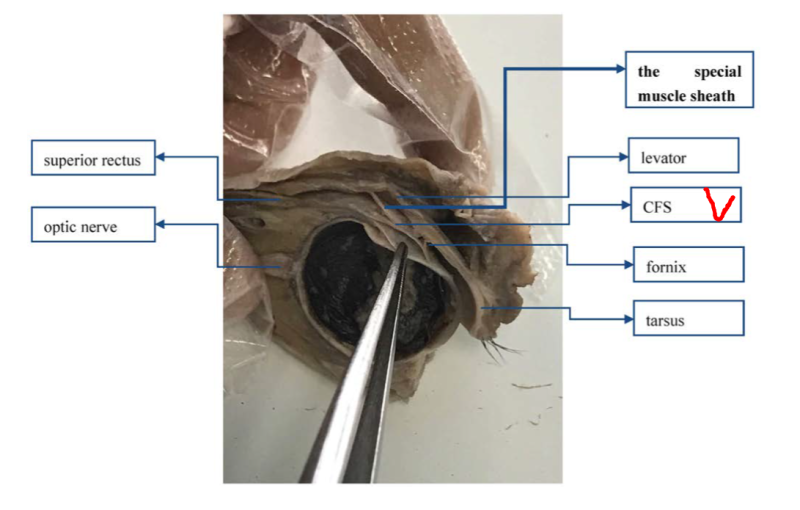
Standard ptosis surgery is usually insufficient for such conditions. To achieve effective results, the surgeon must locate and operate on a deep tissue structure within the eye called the ‘conjoint fascial sheath’ (CFS).
This surgery requires advanced technical skills and is primarily performed by highly experienced plastic surgeons.
The area marked above is the CFS tissue, which is located almost directly above the eyeball. It is difficult to locate and even harder to dissect; it is a procedure that surgeons may find daunting unless they are highly skilled.
This surgery was first introduced by a surgeon named Holmström. The technique was significantly advanced in Korea, and currently, many surgeons in China are also adopting these methods.
This patient came to us in this condition from another hospital. They were born with one eye that barely opened. Even after surgery at another clinic, the eye still wouldn’t open properly, and they visited us because the eye could neither open nor close fully.
This is the appearance immediately after surgery. The eye opens well, but it does not close completely yet. This aspect will improve as time passes.
The patient returned for a follow-up two years after the surgery. The pupil exposure is now almost identical in size, and the eye closes much better. While it is difficult to achieve perfect symmetry when severe ptosis is present on only one side, it is possible to make them look nearly identical.
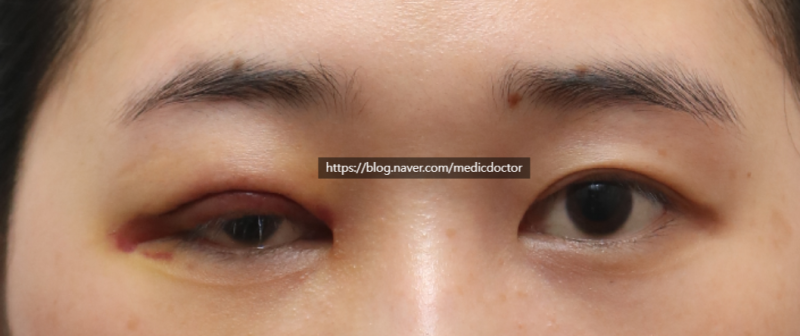
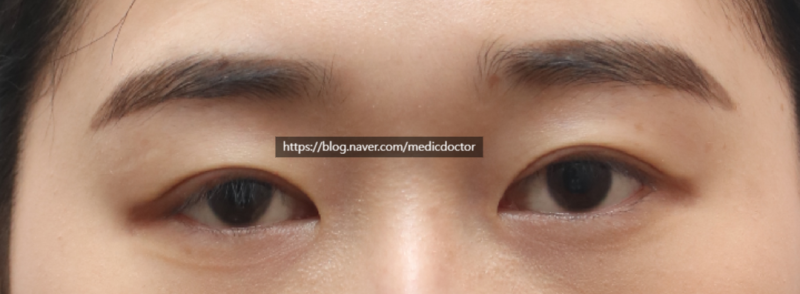
Comparison of before and after surgery.
The surgery appears to have been very successful.
Frequently Asked Questions
Can severe ptosis be treated with general blepharoplasty?
No, general blepharoplasty often cannot resolve severe ptosis. Severe congenital ptosis, where the eyes appear very sleepy and are difficult to open, requires surgery that targets a tissue called the common fascial sheath (CFS) deep within the eye to be effective.
What kind of surgery is the common fascial sheath (CFS) surgery?
Yes, it is a highly complex surgery that involves locating and dissecting the common fascial sheath, a deep tissue attached almost to the top of the eyeball. Because the process of locating and dissecting the tissue is very difficult, it is essential to have the surgery performed by an experienced and skilled plastic surgeon.
Is it normal for my eyes not to close completely immediately after surgery?
Yes, immediately after surgery, even if your eyes open well, they may not close completely. This is a normal part of the recovery process, and the ability for your eyes to close will gradually improve naturally over time, so you don't need to worry too much.
Is perfect symmetry possible when only one eye has severe ptosis?
No, achieving perfect symmetry is realistically difficult. However, common fascial sheath surgery can make the size of both pupils almost similar and significantly improve the degree to which the eyes close, correcting them so that there is no discomfort in daily life.