2026-05-29
Correcting Triple Eyelid Folds with the Two-Line Method: Video Reviews of Pre-op, Immediate Post-op, and 1-Week Progress
A detailed look at correcting high, sausage-like triple eyelids using the two-line method, featuring surgical insights and recovery progress videos.
I have titled this post as follows:
Correcting Triple Eyelid Folds (Triple Eyelids) with the Two-Line Method: Video Reviews of Pre-op, Immediate Post-op, and 1-Week Progress
This patient visited our clinic after searching online. While most of our patients come through referrals, we occasionally have patients who find us through search results.
The patient stated that after their initial surgery, a double eyelid formed along the incision line.
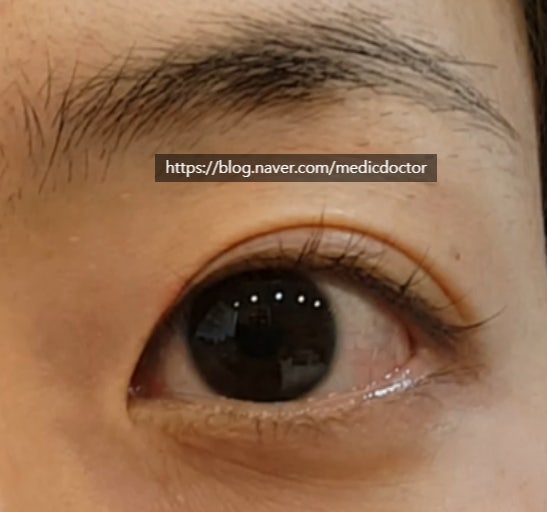
The upper arrow indicates the line formed by adhesions, while the lower arrow indicates the original incision line from the first surgery.
In this case, the double eyelid did not form at the original surgical site; instead, a fold appeared in an area that was not even part of the incision.
This occurs when there are strong internal adhesions combined with a lack of volume, resulting in what looks like ‘sausage eyelids’.
Sausage? Sawsage? However you prefer to spell it...
These are the pre-operative photos of the eyes closed and open. You can see the triple fold and a high sausage-like appearance.
The other eye has a well-defined double eyelid following the incision line.
The correction plan is to smooth out the line on the affected side and adjust the inner corner of the opposite eye to make the line slightly more visible.
While some choose to operate on only one eye, it is my personal opinion that when the previous surgeon is different, differences in surgical techniques can arise. Therefore, I recommend redoing both sides for a more cohesive result.
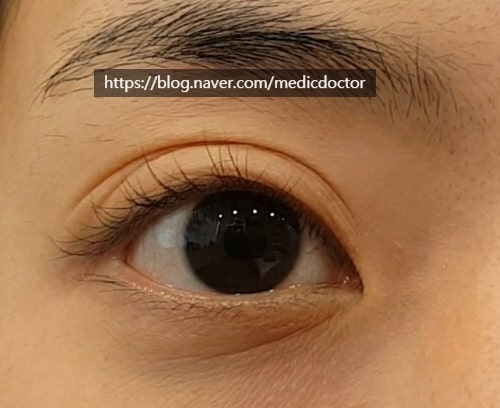
This is the photo without the arrows.
The surgical plan involves preventing re-adhesion in the area where the upper line forms while reinforcing volume.
Referring to a lecture I previously gave at an academic conference:
https://blog.naver.com/medicdoctor/221353621318
This is part of a lecture I was invited to give at the Dongguk University Department of Plastic Surgery in 2016.

Imagine gluing a stiff board, a thin piece of paper, and another stiff board together. When you try to fold it, the stiff boards won’t bend, so the fold naturally occurs at the thin paper section.
However, if you have two layers of thin paper between the boards, the fold could happen at the top layer or the middle layer. Our typical double eyelid surgery is like a ‘Board - A4 Paper - Board’ structure. We aim for the fold to occur at the appropriate spot on the A4 paper. The upper board represents the area near the eyebrow, and the lower board represents the area near the eyelashes.
In other words, if the skin near the eyebrow is thin and there are adhesions there, it becomes the cause of triple eyelids.
I believe this explanation will be useful for any plastic surgery specialists who might be reading this for study purposes.
The three core points of the surgery are: Upper volume reinforcement, Adhesion release, and Prevention of re-adhesion.
The adhesions were released, and volume was reinforced in the upper area (below the eyebrow).
This is the appearance after one week.
The correction went well. The patient did have one question, though.
They were concerned that another line seemed to be forming at the top. For a moment, I wondered if it was re-adhesion, but re-adhesion rarely occurs in the hands of an experienced surgeon.
I will explain what this is using an illustration.
As some may have noticed, if a previous line has been folded for a long time, it can remain slightly like a wrinkle. This doesn’t mean the triple eyelid wasn’t corrected; rather, the skin remains creased because it was folded there for so long.
Consider people with naturally small eyes who use their forehead muscles for a long time; they develop deep forehead wrinkles. Even after resolving the issue with ptosis correction or skin excision so they no longer use those muscles, the wrinkles remain.
However, in younger patients, these fade over time to the point where they are barely noticeable. Since it has only been one week and the stitches were just removed, the bruising has formed in a line, making it stand out more. There is absolutely no need to worry. I will upload further updates during future follow-up visits.