2026-05-29
Releasing Eye Tension After Incisional Ptosis Correction
A case study on early revision to release severe eye tension and asymmetry following incisional ptosis correction at another clinic.
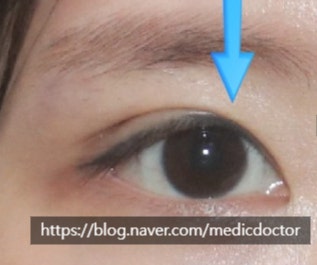
It has been a while since my last post.
Today’s topic is
Releasing Eye Tension After Ptosis Correction
This is a patient case study.
This patient visited us after undergoing incisional ptosis correction at another clinic, suffering from severe asymmetry and a pulling sensation (eye tension). Therefore, we decided to proceed with early revision.
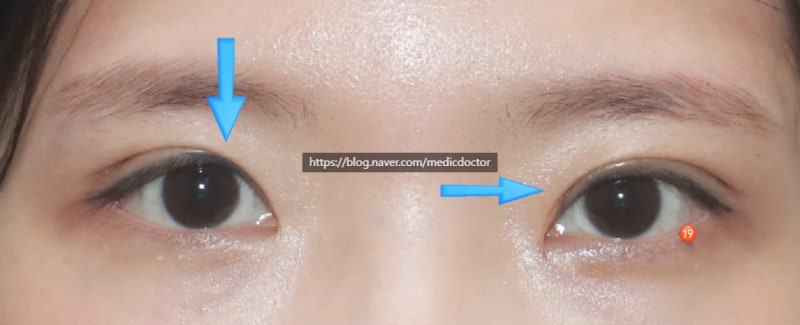
If you look at the patient’s right eye (the left side of the photo), the inner corner is peaked like a mountain. In the left eye (the right side of the photo), the line at the inner corner appears kinked.
During the initial consultation at our clinic before the patient chose the other hospital, I suggested that ptosis correction was unnecessary and recommended only double eyelid surgery. Unfortunately, the patient underwent ptosis correction elsewhere. Since aesthetic judgment is subjective, diagnoses can vary between surgeons.
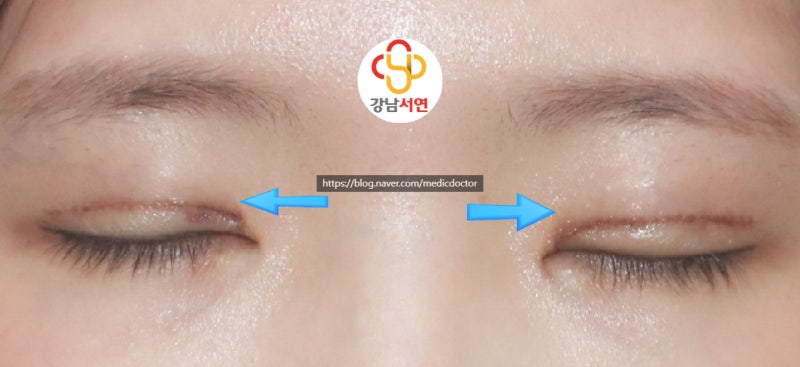
This is the view when the eyes are closed. There is severe sunken scarring, particularly in the inner corner (near the nose), suggesting that a significant amount of tissue was removed during the previous surgery.
Early revision is typically performed between 1 to 3 weeks post-op.
When there is eye tension due to asymmetry, correcting the line asymmetry is difficult because the original designs differ, meaning some line asymmetry may remain. Line asymmetry may require further revision later.
The goal of early revision is focused on making the pupils appear symmetrical. While one could wait 6 months, that would require a more complex procedure called ‘retraction surgery,’ which makes the process much more involved.
The purpose of early ptosis revision is to properly release the areas where the ptosis correction was performed.
This is the appearance 1 week after the early revision. The pupil symmetry looks good, doesn’t it? However, because the underlying designs are different, there is still a difference in the inner corners.
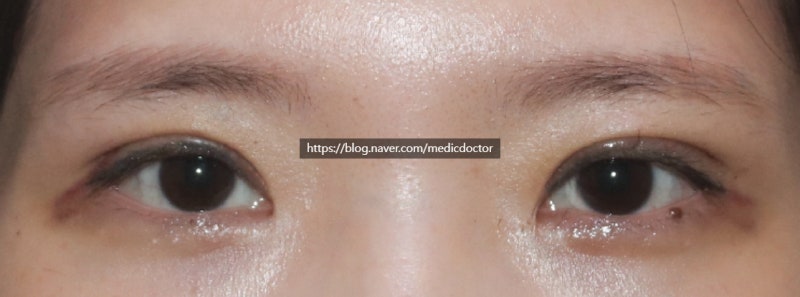
These are photos taken 3 months after the surgery.
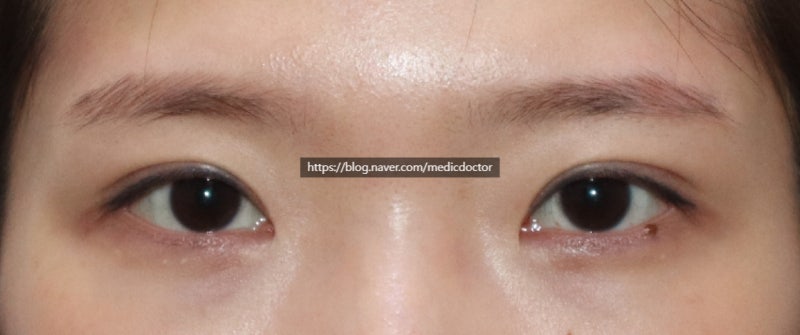
At the 3-month mark, the pulling sensation from the ptosis correction has been alleviated, and the double eyelid asymmetry has improved. Although the designs differ when the eyes are closed, they appear similar because the fixation was changed to a weaker setting.
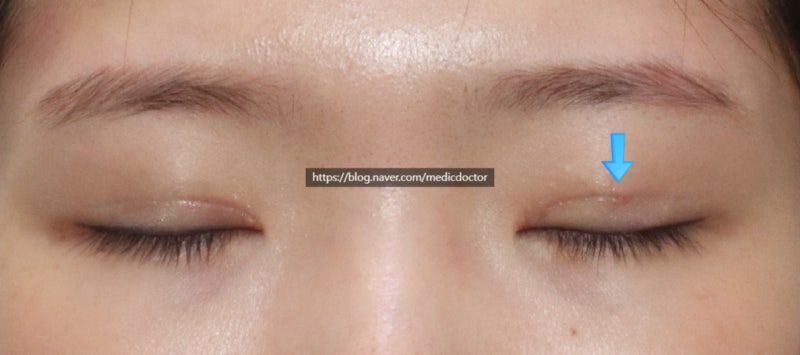
This is the view with eyes closed at 3 months. Patients don’t usually visit at the 3-month mark, but this patient came in because a suture used for fixation became exposed and needed removal.
Occasionally, the sutures used to create the double eyelid can become exposed. Some individuals have a constitution that pushes out foreign substances. Removing them is not a major issue; usually, medical-grade sutures are left in for life if there are no problems. Removing an exposed suture does not cause the double eyelid to unravel. The arrow points to the small area where the suture was exposed.
Since a lot of tissue had already been removed, it was difficult to make the fixation very weak, but by pulling in as much surrounding tissue as possible to flatten the area, the scars seem to be fading gradually.
In double eyelid surgery, scar improvement is possible if there is enough existing tissue left. In revision cases where tissue is lacking, improvement is often limited. Whether a scar improves after revision depends heavily on the first surgery and the surgery immediately preceding it.
In most cases, if there is a pulling sensation after ptosis correction, releasing it immediately brings relief. however, relief from tension symptoms is not 100% guaranteed. This is because if the nerves or tissues were irritated during the initial ptosis surgery, symptoms can sometimes persist for a long time.